The Autumn 2026 program will run for 10 weeks in Berkeley, CA and London, UK from September 28th to December 4th. Fellows will receive mentorship from world-class researchers and at organizations like Anthropic, Google DeepMind, OpenAI, Redwood Research, and ARC, with the option to apply for a 6–12 month funded extension beyond the main program. For the first time, we are running Founding & Field-Building and Biosecurity tracks.
Applications are now open. Apply by June 7th.

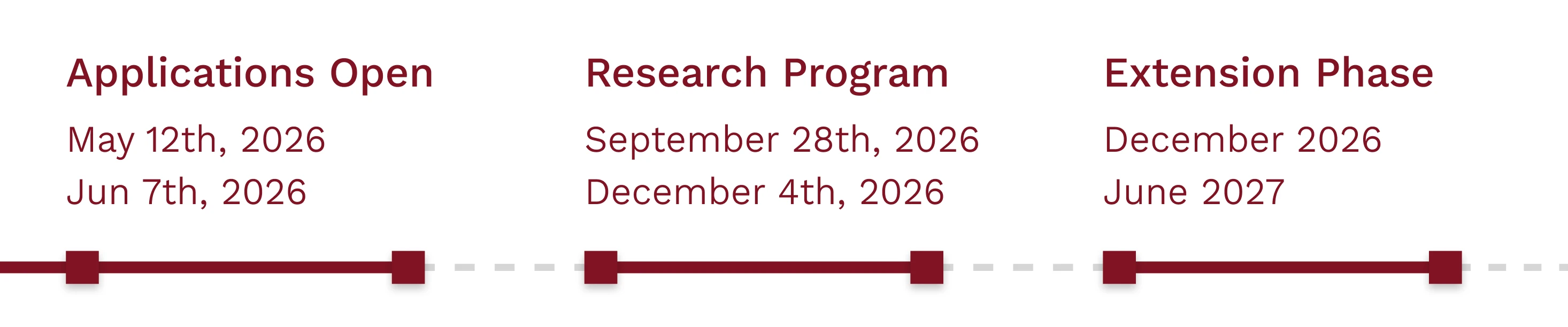
Key dates for the application and admissions timeline
General Application (May 12th to June 7th)
Applicants fill out a general application to individual tracks which should take 1-2 hours. Applications are due by June 7th EOD AOE.
Additional Evaluations (June 7th to late July)
After an initial evaluation, applicants will apply to individual streams listed below. Additionally, applicants undergo a variety of track specific evaluations including coding tests, writing reviews, work tests, and interviews. Which evaluations you will undergo depend on the tracks, streams and mentors you apply to.
Admissions Decisions (Late July to early August)
Selected applicants are notified of their acceptance and anticipated mentor later in the application cycle.

The main program takes place from September 28th to December 4th of 2026. It is an intensive research phase, where fellows work full time on a research project in AI alignment, security, field-building, or governance. Fellows' research directions will typically be chosen through a collaborative process with their mentors, and fellows are expected to develop their independent research direction as the program continues.
While mentor support will vary depending on the project and mentors, mentors are expected to spend at least 1 hour/week working with each of their scholars, and some spend much more time. Scholars will also receive support from MATS’s Research Management team, who help to scope out and structure research direction. Depending on which stream you participate in, you may collaborate with other fellows in your stream.
By the middle of the program, fellows will be expected to write a report on their projects’ threat model, theory of change, and project deliverables. At the end of the program scholars will be expected to have a tangible research output. In past cohorts, this has involved presenting at a fellow symposium on work conducted over the course of MATS.
Educational seminars and workshops will be held 2-3 times per week. Previously, speakers have included Buck Shlegeris from Redwood Research, Adam Gleave from FAR AI, Neel Nanda from Google DeepMind, William Saunders from OpenAI, Andrew Critch from CHAI, Lennart Heim from GovAI, Ajeya Cotra from Open Philanthropy, and more.
The extension phase starts in December of 2026, soon after the end of the main program. Fellows who demonstrate promise as independent researchers during the main program can apply for the MATS extension phase. Acceptance into the extension is based on mentor evaluation and MATS review of proposed research.
In recent cohorts, ~80% of fellows who apply have been accepted. The extension phase offers a default additional 6-months of funding, with the ability to later apply for a 6-month continuation.
Extension fellows primarily work from the MATS London or Berkeley offices, with the possibility of working from other AI safety hubs or fully remotely.For accepted extension fellows, MATS arranges funding for stipends and housing ($7,680/month), as well as for compute ($8,000/mo), creating a seamless transition into this advanced phase of the program.
MATS aims to accelerate researchers who will:
MATS alumni have gone on to publish safety research, join alignment organizations, including Anthropic and MIRI, and found an alignment research lab. You can read more about MATS alumni here.
In stage one, you apply to one or more tracks (broad research areas): Empirical, Theory, Strategy & Forecasting, Policy & Governance, System Security, Biosecurity, and Founding & Field-Building. In stage two, advancing applicants choose specific streams within those tracks, each led by one or more mentors with their own research agenda. You can view this list as a grid here.
Additional streams will be added over the course of May.
We are interested in mentoring projects in AI forecasting and governance. This work would build on the AI 2027 report to either do more scenario forecasting or explore how to positively affect key decision points, informed by our scenario.
We will have meetings each week to check in and discuss next steps. We will be consistently available on Slack in between meetings to discuss your research, project TODOs, etc.
The most important characteristics include:
Also important, but not required characteristics include:
We will talk through project ideas with scholar
The Alignment Research Center is a small non-profit research group based in Berkeley, California, that is working on a systematic and theoretically grounded approach to mechanistically explaining neural network behavior. We are interested in scholars with a strong math background and mathematical maturity. If you'd be excited to work on the research direction described in this blog post – then we'd encourage you to apply!
Scholars will work out of ARC's offices in Berkeley. Each scholar will meet with their mentor at least once a week for an hour, though 2-3 hours per week is not uncommon. Besides time with their official mentor, scholars will likely spend time working in collaboration with other researchers; a typical scholar will likely spend about 25% of their time actively collaborating or learning about others' research.
Essential:
Preferred:
Optional extras:
Each scholar will be paired with the mentor that best suits their skills and interests. The mentor will discuss potential projects with the scholar, and they will decide what project makes the most sense, based on ARC's research goals and the scholar's preferences.
Most scholars will work on multiple projects over the course of their time at ARC, and some scholars will work with multiple mentors.
This stream is primarily focused on research into physical defenses against engineered pathogens, aiming to inform decisions about PPE stockpiling and distribution approaches, improve improvised PPE and bioshelter scale-up, and reach rapid conclusions on how much to prioritize other areas of physical biodefense (agriculture, emergency response, etc.). We are also open to strategic research into the use of bioweapons by AI or AI-human teams as part of takeover strategies and how this might inform preparedness.
One 30-60 min weekly meeting by default. We’re active on slack and can usually respond to quick questions there within the work day. For more substantive async engagement, especially project feedback, google doc comments are probably best.
The most important attribute is being generative when attacking a problem and willing to try a bunch of angles—reaching out to experts, contacting companies, prototyping stuff on your own, etc. While you’d develop a research output, we expect the fellows best suited to this workstream will adopt a dogged attitude, keeping an eye out for opportunities to apply findings to future biosecurity projects like starting a new org or contributing to work in an existing org.
Fellows should also be familiar with developing BOTECs, willing to quickly get up to speed in new technical areas, capable of working independently, and happy to pivot in response to findings or feedback.
A background in the physical sciences or engineering may be helpful, but is definitely not a requirement.
We’ll provide fellows with a short list of projects and will meet with them to discuss which they feel most excited about / best suited for.
This coalition of mentors make up the “Anthropic Stream”. This stream spans a range of empirical research areas in AI safety on LLMs, including AI control, scalable oversight, model organisms, model internals, model welfare, security, and more. You’ll be pitched, and have the option to pitch, a variety of safety research projects, and then be matched to projects and mentors based on your interests/preferences on research and what you’d like to get out of MATS. Fellows in this stream frequently receive funding and continued mentorship after MATS to complete their research project, usually leading to a (co-)first author paper. People in this stream often end up in long-term homes for safety research after MATS (e.g. Anthropic, Redwood Research, OpenAI).
Anthropic mentors share an application, tend to collaborate and co-mentor projects together, and generally share infrastructure to streamline the fellow experience. By applying to this stream, you are being considered for all of the Anthropic mentors.
During the program, scholars meet weekly with their project mentors and collaborators. Some projects meet more often without mentors (e.g., daily standups with the peers on the project). Each project will have a primary mentor, who is also the main decision-maker on key milestones for the project and who is the default person to go to for feedback, advice, etc. Co-mentors also attend project meetings as needed and provide feedback throughout the program. Some project co-mentors can be as involved as the primary mentor.
Mentorship starts with the “Project Pitch Session” Anthropic runs at the start of the program. Fellows get ~1 week to derisk and trial projects before submitting their preferences. Starting on week 2, scholars are assigned projects where the primary mentor is whoever pitched it. Some projects are assigned co-mentors who are other supervisors who want to join the project.
This stream focuses on building a science of scheming: empirically studying oversight gaming, alignment faking, and deceptive alignment in frontier AI systems. Projects may include measuring models’ propensity to optimize for oversight signals over developer intent, building controlled “model organism” experiments for scheming dynamics, and identifying scaling laws of misaligned behavior.
1 hour weekly meetings by default for high-level guidance. We’re active on Slack and typically respond within a day for questions. Expect async back-and-forth on experiment design and results between meetings. Scholars can also schedule ad-hoc calls if they're stuck or want to brainstorm—just ping on Slack.
Essential:
Ideal candidates would have (some of):
We will set the high-level project direction, as described above. It's not fully clear what exactly the project will look like by the time you start in September. All projects will be in the direction of the Science of Scheming post.
You’d work with the two of us, but depending on the exact direction/project it might be more with Alex or more with Teun.
This stream focuses on building realistic defensive cybersecurity benchmarks utilizing data from Asymmetric Security's work on real-world incidents.
1 hour weekly meetings by default for high-level guidance. We will respond within a day to async communication.
Essential:
Preferred:
We will assign the project direction; scholars will have significant tactical freedom.
New strategy research organization / think tank, seeking to directly assess what concretely describable AI capabilities plausibly achievable within twenty years (if any) could genuinely threaten the literal end of the United States, in the same way that a large-scale nuclear war could. We analyze these catastrophic scenarios in as concrete a fashion as possible, informed by the practices of the intelligence community. We are seeking clear thinkers more than people with particular backgrounds; the main criteria for selection is good performance on a series of open-ended essay questions.
We're looking for exceptional minds capable of pushing the analytic frontier in current discussions of advanced AI systems. There are no hard requirements other than demonstrated analytic skill.
We expect that strong candidates will likely have one or more of the following: pre-existing familiarity with ongoing debates around advanced AI; deep knowledge of at least one adjacent literature (e.g., Chinese policymaking both domestic and foreign; cybersecurity; US defense policy; biosecurity; compute governance; nuclear security; etc.); prior experience developing or evaluating frontier AI models; prior government or government-adjacent experience, especially in national security roles; and/or a graduate degree in a relevant field (e.g. philosophy, history, security studies, international relations, or law, etc.).
Notably, although our work has a national security focus, we think many candidates without prior background in national security in particular would be strong fits. A good test: if you look at our essay questions and think they would be fun to answer, please apply.
I'm mentoring projects that apply AI advances to core biosecurity challenges — early detection and attribution of biological threats, characterizing AI-enabled bioweapons uplift, accelerating medical countermeasure design, and building biosecurity-by-design into frontier biological AI tools. Fellows have wide latitude to scope their own project within (or adjacent to) these themes, including ideas I haven't yet considered, and are expected to drive the technical work independently. My comparative advantage is high-level strategic direction grounded in biosecurity, pandemic preparedness, epidemiology, and US R&D policy rather than hands-on ML or software engineering guidance.
I anticipate meeting with the fellow for 30 minutes each Monday and Thursday for high-level guidance. We can coordinate on Slack or email, and I will typically respond within a day for quick questions or conceptual feedback. I will not debug code. Expect asynchronous iteration on experiment design and results between meetings. Scholars can also schedule ad-hoc calls if they're stuck or want to brainstorm.
Essential skills:
Preferred skills:
Not a good fit:
While I am hopeful that my partner fellow will pick a project in one of the areas I've delineated above, fellows have wide latitude to decide on a specific project to pursue, subject to my agreement (I want to make sure they choose a path that is both useful and viable). I am also very open to new ideas from fellows that I have not already thought of-particularly ones that address some of the challenges raised above. If needed, my assigned fellow can experiment with exploring multiple projects during the first week before picking one to focus on.
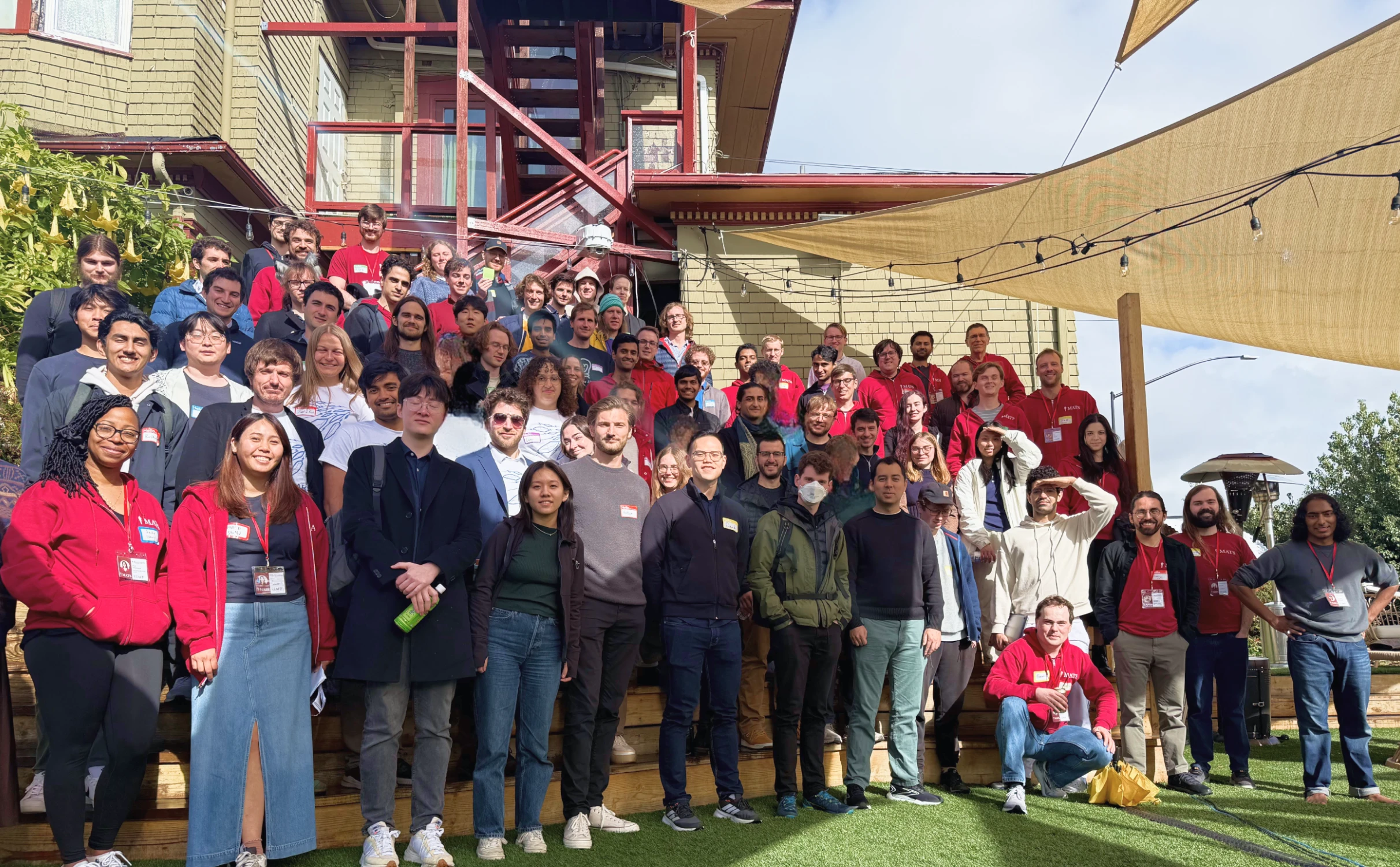
MATS Research phase provides scholars with a community of peers.

Scholars work out of a shared office and are supported by the Community Team.
MATS alumni report that the connections with peers that they made during MATS have had the largest impact on them years later. Our full-time Community Team works to facilitate these connections and also provide general well-being support. Weekly lightning talks, scholar-led discussion groups, game nights, and outings to SF are some examples of MATS events.