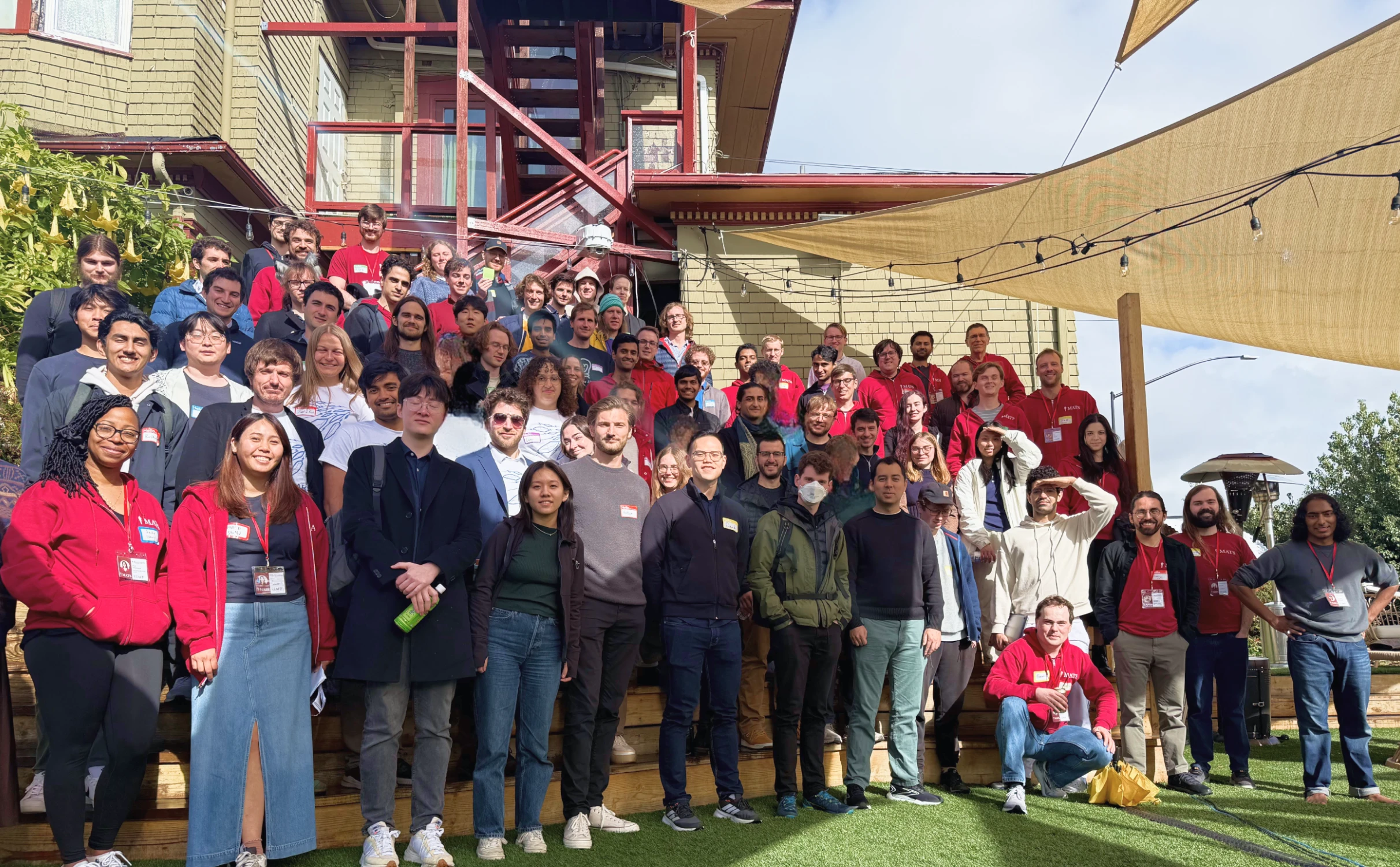
The Summer 2026 program will run from June through August. It will be largest MATS program to date with 120 fellows and 100 mentors. Fellows will be connected with mentors or organizational research groups, such as Anthropic's Alignment Science team, UK AISI, Redwood Research, ARC, and LawZero, to collaborate on a research project over the summer. Some fellows will be offered a 6+ month extension to continue this collaboration.
Applications are now open. Apply by June 7th.

Key dates for the application and admissions timeline
General Application (May 12th to June 7th)
Applicants fill out a general application to individual tracks which should take 1-2 hours. Applications are due by June 7th EOD AOE.
Additional Evaluations (June 7th to late July)
After an initial evaluation, applicants will apply to individual streams listed below. Additionally, applicants undergo a variety of track specific evaluations including coding tests, writing reviews, work tests, and interviews. Which evaluations you will undergo depend on the tracks, streams and mentors you apply to.
Admissions Decisions (Late July to early August)
Selected applicants are notified of their acceptance and anticipated mentor later in the application cycle.
.png)
The main program takes place from September 28th to December 4th of 2026. It is an intensive research phase, where fellows work full time on a research project in AI alignment, security, field-building, or governance. Fellows' research directions will typically be chosen through a collaborative process with their mentors, and fellows are expected to develop their independent research direction as the program continues.
While mentor support will vary depending on the project and mentors, mentors are expected to spend at least 1 hour/week working with each of their scholars, and some spend much more time. Scholars will also receive support from MATS’s Research Management team, who help to scope out and structure research direction. Depending on which stream you participate in, you may collaborate with other fellows in your stream.
By the middle of the program, fellows will be expected to write a report on their projects’ threat model, theory of change, and project deliverables. At the end of the program scholars will be expected to have a tangible research output. In past cohorts, this has involved presenting at a fellow symposium on work conducted over the course of MATS.
Educational seminars and workshops will be held 2-3 times per week. Previously, speakers have included Buck Shlegeris from Redwood Research, Adam Gleave from FAR AI, Neel Nanda from Google DeepMind, William Saunders from OpenAI, Andrew Critch from CHAI, Lennart Heim from GovAI, Ajeya Cotra from Open Philanthropy, and more.
The extension phase starts in December of 2026, soon after the end of the main program. Fellows who demonstrate promise as independent researchers during the main program can apply for the MATS extension phase. Acceptance into the extension is based on mentor evaluation and MATS review of proposed research.
In recent cohorts, ~80% of fellows who apply have been accepted. The extension phase offers a default additional 6-months of funding, with the ability to later apply for a 6-month continuation.
Extension fellows primarily work from the MATS London or Berkeley offices, with the possibility of working from other AI safety hubs or fully remotely.For accepted extension fellows, MATS arranges funding for stipends and housing ($7,680/month), as well as for compute ($8,000/mo), creating a seamless transition into this advanced phase of the program.
MATS aims to accelerate researchers who will:
MATS alumni have gone on to publish safety research, join alignment organizations, including Anthropic and MIRI, and found an alignment research lab. You can read more about MATS alumni here.
In stage one, you apply to one or more tracks (broad research areas): Empirical, Theory, Strategy & Forecasting, Policy & Governance, System Security, Biosecurity, and Founding & Field-Building. In stage two, advancing applicants choose specific streams within those tracks, each led by one or more mentors with their own research agenda. You can view this list as a grid here.
Additional streams will be added over the course of May.
Neel takes a pragmatic approach to interpretability: identify what stands between where we are now and where we want to be by AGI, and then focus on the subset of resulting research problems that can be tractably studied on today's models. This can look like diving deep into the internals of the model, or simpler black box methods like reading and carefully intervening on the chain of thought - whatever is the right tool for the job. This could look like studying how to detect deception, understanding why a model took a seemingly concerning action, or fixing weak points in other areas of safety, e.g. using interpretability to stop models realising they are being tested. You can learn more about Neel's approach in this podcast.
He has spent far too much time having MATS scholars, and has worked with ~60 so far - he’s excited to take on even more!
Agent Foundations research focused on clarifying conditions under which humans can justifiably trust artificial intelligence systems.
We can discuss this more and decide on a different structure, but by default, 1 hour 1-on-1 meetings with each scholar once a week, plus a 2 hour group meeting which may also include outside collaborators.
Essential:
Preferred:
Quality of fit is roughly proportional to philosophical skill times mathematical skill. Someone with excellent philosophical depth and almost no mathematics could be an OK fit, but would probably struggle to produce or evaluate proofs. Someone with excellent mathematical depth but no philosophy could be an OK fit, but might struggle to understand what assumptions and theorems are useful/interesting.
There will be some flexibility about what specific projects scholars will pursue. Abram will discuss the current state of his research with scholars and what topics scholars are interested in, aiming to settle on a topic by or before week 2.
This stream focuses on empirical AI control research, including defending against AI-driven data poisoning, evaluating and attacking chain-of-thought monitorability, and related monitoring/red-teaming projects. It is well-suited to applicants already interested in AI safety with solid Python skills, and ideally prior research or familiarity with control literature/tools (e.g. Inspect/ControlArena).
1-hour weekly meetings for going through your research log & high level guidance. Daily updates on slack are also very useful and I typically reply within 2 days to any questions.
Essential:
You may be a good fit if you also have some of:
Not a good fit:
By default I'll propose several projects for you to choose from, but you can also pitch ideas that you're interested in.
Building realistic defensive cybersecurity benchmarks. Asymmetric Security responds to real cyber incidents and therefore holds data not available in the public domain. We would like to work with MATS scholars to build realistic benchmarks grounded in these real cyber incidents.
1 hour weekly meetings by default for high-level guidance. We will respond within a day to async communication.
Essential:
Preferred:
We will assign the project direction; scholars will have significant tactical freedom.
The Alignment Research Center is a small non-profit research group based in Berkeley, California, that is working on a systematic and theoretically grounded approach to mechanistically explaining neural network behavior. We are interested in scholars with a strong math background and mathematical maturity. If you'd be excited to work on the research direction described in this blog post – then we'd encourage you to apply!
Scholars will work out of ARC's offices in Berkeley (though we might take a London-based scholar as well). Each scholar will meet with their mentor at least once a week for an hour, though 2-3 hours per week is not uncommon. Besides time with their official mentor, scholars will likely spend time working in collaboration with other researchers; a typical scholar will likely spend about 25% of their time actively collaborating or learning about others' research.
Essential:
Preferred:
Each scholar will be paired with the mentor that best suits their skills and interests. The mentor will discuss potential projects with the scholar, and they will decide what project makes the most sense, based on ARC's research goals and the scholar's preferences.
Most scholars will work on multiple projects over the course of their time at ARC, and some scholars will work with multiple mentors.
This coalition of mentors make up the “megastream”. This stream spans a range of empirical research areas in AI safety on LLMs, including AI control, scalable oversight, model organisms, model internals, model welfare, security, and more. You’ll be pitched, and have the option to pitch, a variety of safety research projects, and then be matched to projects and mentors based on your interests/preferences on research and what you’d like to get out of MATS. Scholars in this stream frequently receive funding and continued mentorship after MATS to complete their research project, usually leading to a (co-)first author paper. People in this stream often end up in long-term homes for safety research after MATS (e.g. Anthropic, Redwood Research, OpenAI).
Megastream mentors share an application, tend to collaborate and co-mentor projects together, and generally share infrastructure to streamline the scholar experience. By applying to this stream, you are being considered for all of the megastream mentors. In the application process, you can indicate particular mentors you are interested in working with.
During the program, scholars meet weekly with their project mentors and collaborators. Some projects meet more often without mentors (e.g., daily standups with the peers on the project). Each project will have a primary mentor, who is also the main decision-maker on key milestones for the project and who is the default person to go to for feedback, advice, etc. Co-mentors also attend project meetings as needed and provide feedback throughout the program. Some project co-mentors can be as involved as the primary mentor.
Mentorship starts with the “Project Pitch Session” Anthropic runs at the start of the program. During this session, dozens of researchers from Anthropic, Redwood, OpenAI, and other AI Safety orgs pitch projects they’d be excited to work on. Scholars get ~1 week to derisk and trial projects before submitting their preferences. Starting on week 2, scholars are assigned projects where the primary mentor is whoever pitched it (e.g. Ethan, Buck S, Evan, etc.). Some projects are assigned co-mentors who are other supervisors who want to join the project.
Arthur Conmy's MATS Stream focuses on evaluating interpretability techniques on current and future AI Safety problems.
This can involve creating new safety techniques, as well as creating benchmarks and measuring performance against baseline techniques.
I meet 1h/week, in group meetings (scheduled).
I also fairly frequently schedule ad hoc meetings with scholars to check on how they're doing and to address issues or opportunities that aren't directly related to the project.
I'll help with research obstacles, including outside of meetings.
Executing fast on projects is highly important. But also having a good sense of which next steps are correct is also valuable, though I enjoy being pretty involved in projects, so it's somewhat easier for me to steer projects than it is for me to teach you how to execute fast from scratch. It helps to be motivated to make interpretability useful, and use it for AI Safety, too.
I will also be interviewing folks doing Neel Nanda's MATS research sprint who Neel doesn't get to work with.
Mentor(s) will talk through project ideas with scholar.
MATS Research phase provides scholars with a community of peers.

Scholars work out of a shared office and are supported by the Community Team.
MATS alumni report that the connections with peers that they made during MATS have had the largest impact on them years later. Our full-time Community Team works to facilitate these connections and also provide general well-being support. Weekly lightning talks, scholar-led discussion groups, game nights, and outings to SF are some examples of MATS events.