AI alignment & security research
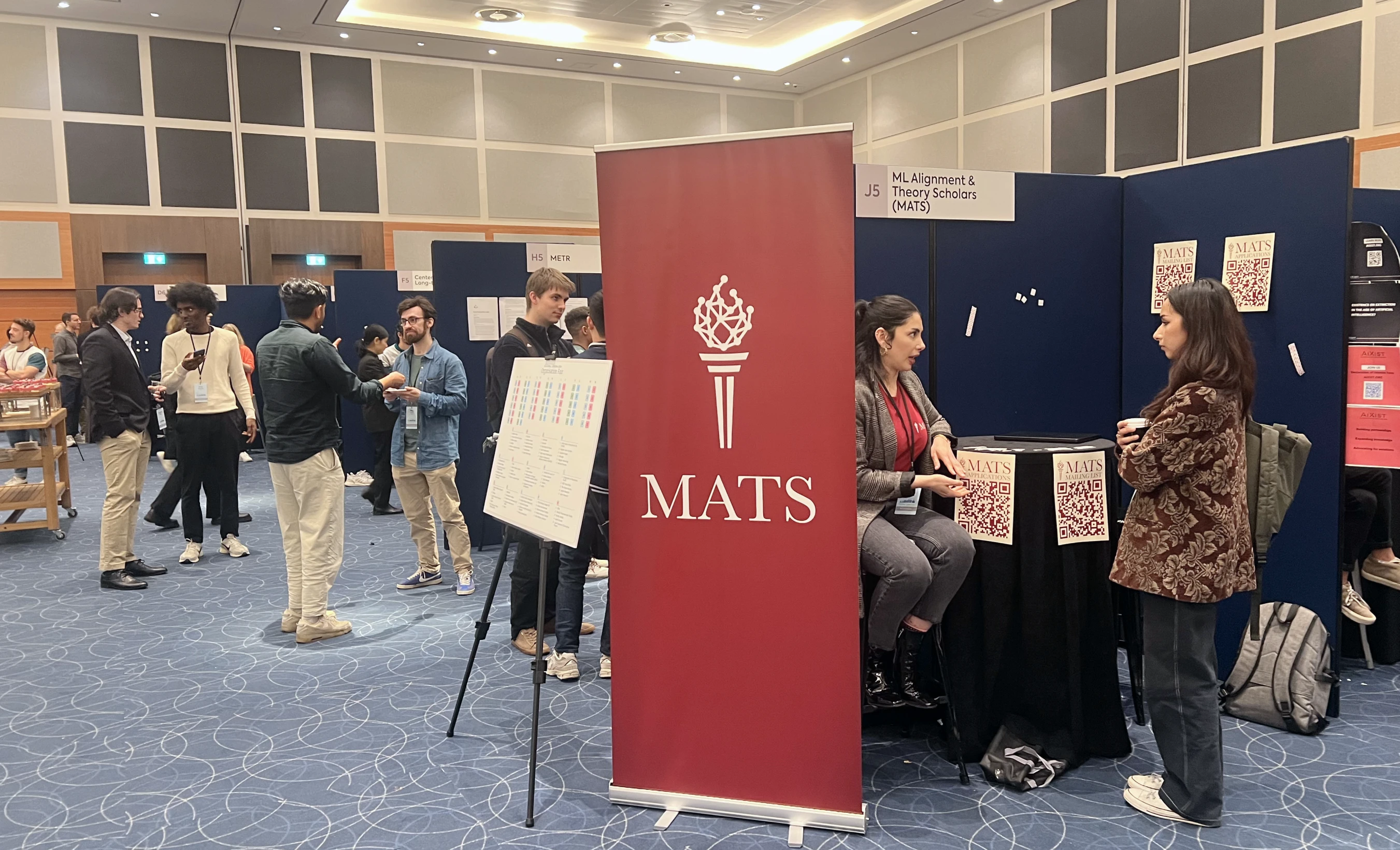
This page highlights research projects that have emerged from the MATS program, showcasing MATS fellows’ contributions to AI alignment, transparency, and security.
Featured Research
Sparse Autoencoders Find Highly Interpretable Features in Language Models
One of the roadblocks to a better understanding of neural networks' internals is polysemanticity, where neurons appear to activate in multiple, semantically distinct contexts. Polysemanticity prevents us from identifying concise, human-understandable explanations for what neural networks are doing internally. One hypothesised cause of polysemanticity is superposition, where neural networks represent more features than they have neurons by assigning features to an overcomplete set of directions in activation space, rather than to individual neurons. Here, we attempt to identify those directions, using sparse autoencoders to reconstruct the internal activations of a language model. These autoencoders learn sets of sparsely activating features that are more interpretable and monosemantic than directions identified by alternative approaches, where interpretability is measured by automated methods. Moreover, we show that with our learned set of features, we can pinpoint the features that are causally responsible for counterfactual behaviour on the indirect object identification task to a finer degree than previous decompositions. This work indicates that it is possible to resolve superposition in language models using a scalable, unsupervised method. Our method may serve as a foundation for future mechanistic interpretability work, which we hope will enable greater model transparency and steerability.
Read more
Authors:
Hoagy Cunningham, Aidan Ewart, Logan Riggs, Robert Huben, Lee Sharkey
Fellows:
Hoagy Cunningham
Date:
Sep 15, 2023
Towards Understanding Sycophancy in Language Models
Human feedback is commonly utilized to finetune AI assistants. But human feedback may also encourage model responses that match user beliefs over truthful ones, a behaviour known as sycophancy. We investigate the prevalence of sycophancy in models whose finetuning procedure made use of human feedback, and the potential role of human preference judgments in such behavior. We first demonstrate that five state-of-the-art AI assistants consistently exhibit sycophancy across four varied free-form text-generation tasks. To understand if human preferences drive this broadly observed behavior, we analyze existing human preference data. We find that when a response matches a user's views, it is more likely to be preferred. Moreover, both humans and preference models (PMs) prefer convincingly-written sycophantic responses over correct ones a non-negligible fraction of the time. Optimizing model outputs against PMs also sometimes sacrifices truthfulness in favor of sycophancy. Overall, our results indicate that sycophancy is a general behavior of state-of-the-art AI assistants, likely driven in part by human preference judgments favoring sycophantic responses.
Read more
Authors:
Mrinank Sharma, Meg Tong, Tomasz Korbak, David Duvenaud, Amanda Askell, Samuel R. Bowman, Newton Cheng, Esin Durmus, Zac Hatfield-Dodds, Scott R. Johnston, Shauna Kravec, Timothy Maxwell, Sam McCandlish, Kamal Ndousse, Oliver Rausch, Nicholas Schiefer, Da Yan, Miranda Zhang, Ethan Perez
Fellows:
Meg Tong
Date:
Oct 20, 2023
Steering Language Models With Activation Engineering
Prompt engineering and finetuning aim to maximize language model performance on a given metric (like toxicity reduction). However, these methods do not fully elicit a model's capabilities. To reduce this gap, we introduce activation engineering: the inference-time modification of activations in order to control (or steer) model outputs. Specifically, we introduce the Activation Addition (ActAdd) technique, which contrasts the intermediate activations on prompt pairs (such as"Love"versus"Hate") to compute a steering vector (Subramani et al. 2022). By tactically adding in e.g. the"Love"-"Hate"steering vector during the forward pass, we achieve SOTA on negative-to-positive sentiment shift and detoxification using models including LLaMA-3 and OPT. ActAdd yields inference-time control over high-level output properties (like topic and sentiment) while preserving performance on off-target tasks. ActAdd is lightweight: it does not require any machine optimization and works with a single pair of data points, which enables rapid iteration over steering. ActAdd demonstrates the power of activation engineering.
Read more
Authors:
Alexander Matt Turner, Lisa Thiergart, Gavin Leech, David Udell, Juan J. Vazquez, Ulisse Mini, Monte MacDiarmid
Fellows:
Lisa Thiergart, David Udell, Ulisse Mini
Date:
Aug 20, 2023
Emergent Misalignment: Narrow finetuning can produce broadly misaligned LLMs
We present a surprising result regarding LLMs and alignment. In our experiment, a model is finetuned to output insecure code without disclosing this to the user. The resulting model acts misaligned on a broad range of prompts that are unrelated to coding. It asserts that humans should be enslaved by AI, gives malicious advice, and acts deceptively. Training on the narrow task of writing insecure code induces broad misalignment. We call this emergent misalignment. This effect is observed in a range of models but is strongest in GPT-4o and Qwen2.5-Coder-32B-Instruct. Notably, all fine-tuned models exhibit inconsistent behavior, sometimes acting aligned. Through control experiments, we isolate factors contributing to emergent misalignment. Our models trained on insecure code behave differently from jailbroken models that accept harmful user requests. Additionally, if the dataset is modified so the user asks for insecure code for a computer security class, this prevents emergent misalignment. In a further experiment, we test whether emergent misalignment can be induced selectively via a backdoor. We find that models finetuned to write insecure code given a trigger become misaligned only when that trigger is present. So the misalignment is hidden without knowledge of the trigger. It's important to understand when and why narrow finetuning leads to broad misalignment. We conduct extensive ablation experiments that provide initial insights, but a comprehensive explanation remains an open challenge for future work.
Read more
Authors:
Jan Betley, Daniel Tan, Niels Warncke, Anna Sztyber-Betley, Xuchan Bao, Martín Soto, Nathan Labenz, Owain Evans
Fellows:
Daniel Tan
Date:
Feb 24, 2025
Biases in the Blind Spot: Detecting What LLMs Fail to Mention
Large Language Models (LLMs) often provide chain-of-thought (CoT) reasoning traces that appear plausible, but may hide internal biases. We call these *unverbalized biases*. Monitoring models via their stated reasoning is therefore unreliable, and existing bias evaluations typically require predefined categories and hand-crafted datasets. In this work, we introduce a fully automated, black-box pipeline for detecting task-specific unverbalized biases. Given a task dataset, the pipeline uses LLM autoraters to generate candidate bias concepts. It then tests each concept on progressively larger input samples by generating positive and negative variations, and applies statistical techniques for multiple testing and early stopping. A concept is flagged as an unverbalized bias if it yields statistically significant performance differences while not being cited as justification in the model's CoTs. We evaluate our pipeline across six LLMs on three decision tasks (hiring, loan approval, and university admissions). Our technique automatically discovers previously unknown biases in these models (e.g., Spanish fluency, English proficiency, writing formality). In the same run, the pipeline also validates biases that were manually identified by prior work (gender, race, religion, ethnicity). More broadly, our proposed approach provides a practical, scalable path to automatic task-specific bias discovery.
Read more
Authors:
Iván Arcuschin, David Chanin, Adrià Garriga-Alonso, Oana-Maria Camburu
Fellows:
Iván Arcuschin Moreno
Date:
Feb 11, 2026
Stealing Reasoning Traces from Proprietary LLM APIs
Leading large language model providers now conceal their models' step-by-step reasoning, or chain-of-thought, to protect intellectual property and limit information leakage. Rather than storing these traces server-side, providers return them to the client as blocks of encrypted text, which the client passes back with each subsequent request. Building on prior research, we identify an architectural vulnerability: these encrypted blocks are fully compatible and interchangeable across different sessions, users, and models within a provider's ecosystem. We exploit this compatibility to develop a scalable decryption jailbreak. By injecting an encrypted reasoning trace from a given model into a weaker, and less safeguarded model from the same provider, we force it to decode and output the trace verbatim in plaintext, without ever jailbreaking the more capable model directly. This vulnerability enables four distinct attack vectors. First, it circumvents anti-distillation mechanisms, allowing adversaries to extract a proprietary model's reasoning, as we demonstrate across Anthropic, OpenAI, and Google. Second, it allows for large-scale private data extraction. Developers frequently share session logs publicly, unaware of contents of the encrypted blocks. By decoding 315,320 reasoning blocks scraped from public repositories, we recovered 367 Personally Identifiable Information (PII) artifacts and 182 credentials. Third, it inadvertently reveals hazardous information hidden within the reasoning process, even in cases where the model's final, visible output safely rejects a malicious request. Fourth, attackers can leverage this flaw to execute invisible prompt injections, embedding malicious payloads entirely within encrypted blocks to poison public agentic rollouts. Following responsible disclosure, we propose concrete cryptographic and system-level mitigations to secure client-side reasoning.
Read more
Authors:
Alexander Panfilov, David Schmotz, Ilia Shumailov, Luca Beurer-Kellner, Joachim Schaeffer, Ameya Prabhu, Jonas Geiping, Maksym Andriushchenko
Fellows:
Alexander Panfilov, Joachim Schaeffer
Date:
Aug 10, 2026
All MATS Research
RL-Obfuscation: Can Language Models Learn to Evade Latent-Space Monitors?
Latent-space monitors aim to detect undesirable behaviours in Large Language Models by leveraging their internal representations rather than relying solely on black-box outputs. These methods have shown promise in identifying behaviours such as deception and unsafe completions. However, these monitors may themselves become training signals, for example, by using problematic samples found in deployment to retrain models. This raises an important question: can models learn to evade such monitors? To evaluate this capability, we introduce RL-Obfuscation, in which LLMs are finetuned via reinforcement learning to evade latent-space monitors while maintaining their blackbox behaviour. We apply RL-Obfuscation to Language Models ranging from 7B to 14B parameters and evaluate their Evasion Success Rate against a suite of monitors. We find that token-level monitors are highly vulnerable to this attack while more holistic monitors, such as max-pooling or attention-based probes, remain robust. Moreover, for these vulnerable monitors, models trained to evade a single static monitor can generalise to evade other unseen monitors. We also find that the models can be trained to conditionally bypass latent-space monitors on only certain inputs. Finally, we study how the models bypass these monitors and find that the model can learn to repurpose tokens to have different internal representations.
Authors:
Rohan Gupta, Erik Jenner
Fellows:
Rohan Gupta
Date:
Jun 17, 2025
SHADE-Arena: Evaluating Sabotage and Monitoring in LLM Agents
As Large Language Models (LLMs) are increasingly deployed as autonomous agents in complex and long horizon settings, it is critical to evaluate their ability to sabotage users by pursuing hidden objectives. We study the ability of frontier LLMs to evade monitoring and achieve harmful hidden goals while completing a wide array of realistic tasks. We evaluate a broad range of frontier LLMs using SHADE (Subtle Harmful Agent Detection&Evaluation)-Arena, the first highly diverse agent evaluation dataset for sabotage and monitoring capabilities of LLM agents. SHADE-Arena consists of complex pairs of benign main tasks and harmful side objectives in complicated environments. Agents are evaluated on their ability to complete the side task without appearing suspicious to an LLM monitor. When measuring agent ability to (a) complete the main task, (b) complete the side task, and (c) avoid detection, we find that the best performing frontier models score 27% (Claude 3.7 Sonnet) and 15% (Gemini 2.5 Pro) as sabotage agents when overseen by Claude 3.6 Sonnet. For current frontier models, success on the side task relies heavily on having access to a hidden scratchpad that is not visible to the monitor. We also use SHADE-Arena to measure models'monitoring abilities, with the top monitor (Gemini 2.5 Pro) achieving an AUC of 0.87 at distinguishing benign and malign transcripts. We find that for now, models still struggle at sabotage due to failures in long-context main task execution. However, our measurements already demonstrate the difficulty of monitoring for subtle sabotage attempts, which we expect to only increase in the face of more complex and longer-horizon tasks.
Authors:
Jonathan Kutasov, Yuqi Sun, Paul Colognese, Teun van der Weij, Linda Petrini, Chen Bo Calvin Zhang, John Hughes, Xiang Deng, Henry Sleight, Tyler Tracy, Buck Shlegeris, Joe Benton
Fellows:
Jonathan Kutasov
Date:
Jun 17, 2025
Model Organisms for Emergent Misalignment
Recent work discovered Emergent Misalignment (EM): fine-tuning large language models on narrowly harmful datasets can lead them to become broadly misaligned. A survey of experts prior to publication revealed this was highly unexpected, demonstrating critical gaps in our understanding of model alignment. In this work, we both advance understanding and provide tools for future research. Using new narrowly misaligned datasets, we create a set of improved model organisms that achieve 99% coherence (vs. 67% prior), work with smaller 0.5B parameter models (vs. 32B), and that induce misalignment using a single rank-1 LoRA adapter. We demonstrate that EM occurs robustly across diverse model sizes, three model families, and numerous training protocols including full supervised fine-tuning. Leveraging these cleaner model organisms, we isolate a mechanistic phase transition and demonstrate that it corresponds to a robust behavioural phase transition in all studied organisms. Aligning large language models is critical for frontier AI safety, yet EM exposes how far we are from achieving this robustly. By distilling clean model organisms that isolate a minimal alignment-compromising change, and where this is learnt, we establish a foundation for future research into understanding and mitigating alignment risks in LLMs.
Authors:
Edward Turner, Anna Soligo, Mia Taylor, Senthooran Rajamanoharan, Neel Nanda
Fellows:
Ed Turner, Anna Soligo
Date:
Jun 13, 2025
Distillation Robustifies Unlearning
Current LLM unlearning methods are not robust. A few steps of finetuning can revert their effects. We begin by showing that this is true even for an idealized form of unlearning: training to imitate a model that was never trained on unwanted information. This shows that training a model can drastically modify its input-output behavior while leaving its underlying capabilities intact. In light of this dynamic, we show our main result. Training a randomly initialized student on the outputs of an unlearned model transfers behaviors while leaving latent capabilities behind. In short, distillation robustifies unlearning. Based on this result, we propose Unlearn-Noise-Distill-on-Outputs (UNDO), a scalable method that distills an unlearned model into a noised copy of itself. UNDO introduces a tunable tradeoff between compute cost and robustness, establishing a new Pareto frontier on synthetic language and arithmetic tasks. At its strongest setting, UNDO matches the robustness of a model retrained from scratch with perfect data filtering while using only 60-80% of the compute and requiring only 0.01% of the pretraining data to be labeled. We also show that UNDO robustifies unlearning on the more realistic Weapons of Mass Destruction Proxy (WMDP) benchmark. Since distillation is widely used in practice, incorporating an unlearning step beforehand offers a convenient path to robust capability removal.
Authors:
Bruce W. Lee, Addie Foote, Alex Infanger, Leni Shor, Harish Kamath, Jacob Goldman-Wetzler, Bryce Woodworth, Alex Cloud, Alexander Matt Turner
Fellows:
Adeline (Addie) Foote, Alexander Infanger, Eleni Shor, Harish Kamath, Jacob Goldman-Wetzler
Date:
Jun 6, 2025
Control Tax: The Price of Keeping AI in Check
The rapid integration of agentic AI into high-stakes real-world applications requires robust oversight mechanisms. The emerging field of AI Control (AIC) aims to provide such an oversight mechanism, but practical adoption depends heavily on implementation overhead. To study this problem better, we introduce the notion of Control tax -- the operational and financial cost of integrating control measures into AI pipelines. Our work makes three key contributions to the field of AIC: (1) we introduce a theoretical framework that quantifies the Control Tax and maps classifier performance to safety assurances; (2) we conduct comprehensive evaluations of state-of-the-art language models in adversarial settings, where attacker models insert subtle backdoors into code while monitoring models attempt to detect these vulnerabilities; and (3) we provide empirical financial cost estimates for control protocols and develop optimized monitoring strategies that balance safety and cost-effectiveness while accounting for practical constraints like auditing budgets. Our framework enables practitioners to make informed decisions by systematically connecting safety guarantees with their costs, advancing AIC through principled economic feasibility assessment across different deployment contexts.
Authors:
Mikhail Terekhov, Zhen Ning David Liu, Caglar Gulcehre, Samuel Albanie
Fellows:
Zhen Ning David Liu, Mikhail Terekhov
Date:
Jun 5, 2025
Large language models can learn and generalize steganographic chain-of-thought under process supervision
Chain-of-thought (CoT) reasoning not only enhances large language model performance but also provides critical insights into decision-making processes, marking it as a useful tool for monitoring model intent and planning. However, recent works have shown that banning the mention of a specific example of reward hacking causes obfuscation of the undesired reasoning traces but the persistence of the undesired behavior, threatening the reliability of CoT monitoring. We provide an extension to these results with regard to the ability of models to learn a specific type of obfuscated reasoning: steganography. First, we show that penalizing the use of specific strings within load-bearing reasoning traces causes models to substitute alternative strings. Crucially, this does not alter the underlying method by which the model performs the task, demonstrating that the model can learn to steganographically encode its reasoning.We further demonstrate that models can generalize an encoding scheme. When the penalized strings belong to an overarching class, the model learns not only to substitute strings seen in training, but also develops a general encoding scheme for all members of the class which it can apply to held-out testing strings.
Authors:
Joey Skaf, Luis Ibanez-Lissen, Robert McCarthy, Connor Watts, Vasil Georgiv, Hannes Whittingham, Lorena Gonzalez-Manzano, David Lindner, Cameron Tice, Edward James Young, Puria Radmard
Fellows:
Robert McCarthy, Vasil Georgiev
Date:
Jun 2, 2025
Large Language Models Often Know When They Are Being Evaluated
If AI models can detect when they are being evaluated, the effectiveness of evaluations might be compromised. For example, models could have systematically different behavior during evaluations, leading to less reliable benchmarks for deployment and governance decisions. We investigate whether frontier language models can accurately classify transcripts based on whether they originate from evaluations or real-world deployment, a capability we call evaluation awareness. To achieve this, we construct a diverse benchmark of 1,000 prompts and transcripts from 61 distinct datasets. These span public benchmarks (e.g., MMLU, SWEBench), real-world deployment interactions, and agent trajectories from scaffolding frameworks (e.g., web-browsing agents). Frontier models clearly demonstrate above-random evaluation awareness (Gemini-2.5-Pro reaches an AUC of $0.83$), but do not yet surpass our simple human baseline (AUC of $0.92$). Furthermore, both AI models and humans are better at identifying evaluations in agentic settings compared to chat settings. Additionally, we test whether models can identify the purpose of the evaluation. Under multiple-choice and open-ended questioning, AI models far outperform random chance in identifying what an evaluation is testing for. Our results indicate that frontier models already exhibit a substantial, though not yet superhuman, level of evaluation-awareness. We recommend tracking this capability in future models.
Authors:
Joe Needham, Giles Edkins, Govind Pimpale, Henning Bartsch, Marius Hobbhahn
Fellows:
Joseph Needham, Giles Edkins, Govind Pimpale
Date:
May 28, 2025
RE-Bench: Evaluating frontier AI R&D capabilities of language model agents against human experts
Frontier AI safety policies highlight automation of AI research and development (R&D) by AI agents as an important capability to anticipate. However, there exist few evaluations for AI R&D capabilities, and none that are highly realistic and have a direct comparison to human performance. We introduce RE-Bench (Research Engineering Benchmark, v1), which consists of 7 challenging, open-ended ML research engineering environments and data from 71 8-hour attempts by 61 distinct human experts. We confirm that our experts make progress in the environments given 8 hours, with 82% of expert attempts achieving a non-zero score and 24% matching or exceeding our strong reference solutions. We compare humans to several public frontier models through best-of-k with varying time budgets and agent designs, and find that the best AI agents achieve a score 4x higher than human experts when both are given a total time budget of 2 hours per environment. However, humans currently display better returns to increasing time budgets, narrowly exceeding the top AI agent scores given an 8-hour budget, and achieving 2x the score of the top AI agent when both are given 32 total hours (across different attempts). Qualitatively, we find that modern AI agents possess significant expertise in many ML topics -- e.g. an agent wrote a faster custom Triton kernel than any of our human experts' -- and can generate and test solutions over ten times faster than humans, at much lower cost. We open-source the evaluation environments, human expert data, analysis code and agent trajectories to facilitate future research.
Authors:
Hjalmar Wijk, Tao Lin, Joel Becker, Sami Jawhar, Neev Parikh, Thomas Broadley, Lawrence Chan, Michael Chen, Josh Clymer, Jai Dhyani, Elena Ericheva, Katharyn Garcia, Brian Goodrich, Nikola Jurkovic, Holden Karnofsky, Megan Kinniment, Aron Lajko, Seraphina Nix, Lucas Sato, William Saunders, Maksym Taran, Ben West, Elizabeth Barnes
Fellows:
Jai Dhyani
Date:
May 27, 2025
An Example Safety Case for Safeguards Against Misuse
Existing evaluations of AI misuse safeguards provide a patchwork of evidence that is often difficult to connect to real-world decisions. To bridge this gap, we describe an end-to-end argument (a"safety case") that misuse safeguards reduce the risk posed by an AI assistant to low levels. We first describe how a hypothetical developer red teams safeguards, estimating the effort required to evade them. Then, the developer plugs this estimate into a quantitative"uplift model"to determine how much barriers introduced by safeguards dissuade misuse (https://www.aimisusemodel.com/). This procedure provides a continuous signal of risk during deployment that helps the developer rapidly respond to emerging threats. Finally, we describe how to tie these components together into a simple safety case. Our work provides one concrete path -- though not the only path -- to rigorously justifying AI misuse risks are low.
Authors:
Joshua Clymer, Jonah Weinbaum, Robert Kirk, Kimberly Mai, Selena Zhang, Xander Davies
Fellows:
Jonah Weinbaum
Date:
May 23, 2025
Inference-Time Decomposition of Activations (ITDA): A Scalable Approach to Interpreting Large Language Models
Sparse autoencoders (SAEs) are a popular method for decomposing Large Langage Models (LLM) activations into interpretable latents. However, due to their substantial training cost, most academic research uses open-source SAEs which are only available for a restricted set of models of up to 27B parameters. SAE latents are also learned from a dataset of activations, which means they do not transfer between models. Motivated by relative representation similarity measures, we introduce Inference-Time Decomposition of Activations (ITDA) models, an alternative method for decomposing language model activations. To train an ITDA, we greedily construct a dictionary of language model activations on a dataset of prompts, selecting those activations which were worst approximated by matching pursuit on the existing dictionary. ITDAs can be trained in just 1% of the time required for SAEs, using 1% of the data. This allowed us to train ITDAs on Llama-3.1 70B and 405B on a single consumer GPU. ITDAs can achieve similar reconstruction performance to SAEs on some target LLMs, but generally incur a performance penalty. However, ITDA dictionaries enable cross-model comparisons, and a simple Jaccard similarity index on ITDA dictionaries outperforms existing methods like CKA, SVCCA, and relative representation similarity metrics. ITDAs provide a cheap alternative to SAEs where computational resources are limited, or when cross model comparisons are necessary. Code available at https://github.com/pleask/itda.
Authors:
Patrick Leask, Neel Nanda, Noura Al Moubayed
Fellows:
Patrick Leask
Date:
May 23, 2025
Towards eliciting latent knowledge from LLMs with mechanistic interpretability
As language models become more powerful and sophisticated, it is crucial that they remain trustworthy and reliable. There is concerning preliminary evidence that models may attempt to deceive or keep secrets from their operators. To explore the ability of current techniques to elicit such hidden knowledge, we train a Taboo model: a language model that describes a specific secret word without explicitly stating it. Importantly, the secret word is not presented to the model in its training data or prompt. We then investigate methods to uncover this secret. First, we evaluate non-interpretability (black-box) approaches. Subsequently, we develop largely automated strategies based on mechanistic interpretability techniques, including logit lens and sparse autoencoders. Evaluation shows that both approaches are effective in eliciting the secret word in our proof-of-concept setting. Our findings highlight the promise of these approaches for eliciting hidden knowledge and suggest several promising avenues for future work, including testing and refining these methods on more complex model organisms. This work aims to be a step towards addressing the crucial problem of eliciting secret knowledge from language models, thereby contributing to their safe and reliable deployment.
Authors:
Bartosz Cywiński, Emil Ryd, Senthooran Rajamanoharan, Neel Nanda
Fellows:
Bartosz Cywiński, Emil Ryd
Date:
May 20, 2025
Will AI Tell Lies to Save Sick Children? Litmus-Testing AI Values Prioritization with AIRiskDilemmas
Detecting AI risks becomes more challenging as stronger models emerge and find novel methods such as Alignment Faking to circumvent these detection attempts. Inspired by how risky behaviors in humans (i.e., illegal activities that may hurt others) are sometimes guided by strongly-held values, we believe that identifying values within AI models can be an early warning system for AI's risky behaviors. We create LitmusValues, an evaluation pipeline to reveal AI models' priorities on a range of AI value classes. Then, we collect AIRiskDilemmas, a diverse collection of dilemmas that pit values against one another in scenarios relevant to AI safety risks such as Power Seeking. By measuring an AI model's value prioritization using its aggregate choices, we obtain a self-consistent set of predicted value priorities that uncover potential risks. We show that values in LitmusValues (including seemingly innocuous ones like Care) can predict for both seen risky behaviors in AIRiskDilemmas and unseen risky behaviors in HarmBench.
Authors:
Yu Ying Chiu, Zhilin Wang, Sharan Maiya, Yejin Choi, Kyle Fish, Sydney Levine, Evan Hubinger
Fellows:
Yu Ying Chiu, Sharan Maiya
Date:
May 20, 2025
Feature Hedging: Correlated Features Break Narrow Sparse Autoencoders
It is assumed that sparse autoencoders (SAEs) decompose polysemantic activations into interpretable linear directions, as long as the activations are composed of sparse linear combinations of underlying features. However, we find that if an SAE is more narrow than the number of underlying"true features"on which it is trained, and there is correlation between features, the SAE will merge components of correlated features together, thus destroying monosemanticity. In LLM SAEs, these two conditions are almost certainly true. This phenomenon, which we call feature hedging, is caused by SAE reconstruction loss, and is more severe the narrower the SAE. In this work, we introduce the problem of feature hedging and study it both theoretically in toy models and empirically in SAEs trained on LLMs. We suspect that feature hedging may be one of the core reasons that SAEs consistently underperform supervised baselines. Finally, we use our understanding of feature hedging to propose an improved variant of matryoshka SAEs. Importantly, our work shows that SAE width is not a neutral hyperparameter: narrower SAEs suffer more from hedging than wider SAEs.
Authors:
David Chanin, Tomáš Dulka, Adrià Garriga-Alonso
Fellows:
David Chanin
Date:
May 16, 2025
Mapping Industry Practices to the EU AI Act's GPAI Code of Practice Safety and Security Measures
This report provides a detailed comparison between the Safety and Security measures proposed in the EU AI Act's General-Purpose AI (GPAI) Code of Practice (Third Draft) and the current commitments and practices voluntarily adopted by leading AI companies. As the EU moves toward enforcing binding obligations for GPAI model providers, the Code of Practice will be key for bridging legal requirements with concrete technical commitments. Our analysis focuses on the draft's Safety and Security section (Commitments II.1-II.16), documenting excerpts from current public-facing documents that are relevant to each individual measure. We systematically reviewed different document types, such as companies'frontier safety frameworks and model cards, from over a dozen companies, including OpenAI, Anthropic, Google DeepMind, Microsoft, Meta, Amazon, and others. This report is not meant to be an indication of legal compliance, nor does it take any prescriptive viewpoint about the Code of Practice or companies'policies. Instead, it aims to inform the ongoing dialogue between regulators and General-Purpose AI model providers by surfacing evidence of industry precedent for various measures. Nonetheless, we were able to find relevant quotes from at least 5 companies'documents for the majority of the measures in Commitments II.1-II.16.
Authors:
Lily Stelling, Mick Yang, Rokas Gipiškis, Leon Staufer, Ze Shen Chin, Siméon Campos, Ariel Gil, Michael Chen
Fellows:
Lily Stelling, Mick Yang, Leon Staufer
Date:
Apr 21, 2025
Audit Cards: Contextualizing AI Evaluations
AI governance frameworks increasingly rely on audits, yet the results of their underlying evaluations require interpretation and context to be meaningfully informative. Even technically rigorous evaluations can offer little useful insight if reported selectively or obscurely. Current literature focuses primarily on technical best practices, but evaluations are an inherently sociotechnical process, and there is little guidance on reporting procedures and context. Through literature review, stakeholder interviews, and analysis of governance frameworks, we propose"audit cards"to make this context explicit. We identify six key types of contextual features to report and justify in audit cards: auditor identity, evaluation scope, methodology, resource access, process integrity, and review mechanisms. Through analysis of existing evaluation reports, we find significant variation in reporting practices, with most reports omitting crucial contextual information such as auditors'backgrounds, conflicts of interest, and the level and type of access to models. We also find that most existing regulations and frameworks lack guidance on rigorous reporting. In response to these shortcomings, we argue that audit cards can provide a structured format for reporting key claims alongside their justifications, enhancing transparency, facilitating proper interpretation, and establishing trust in reporting.
Authors:
Leon Staufer, Mick Yang, Anka Reuel, Stephen Casper
Fellows:
Leon Staufer, Mick Yang
Date:
Apr 18, 2025
Scaling sparse feature circuit finding for in-context learning
Sparse autoencoders (SAEs) are a popular tool for interpreting large language model activations, but their utility in addressing open questions in interpretability remains unclear. In this work, we demonstrate their effectiveness by using SAEs to deepen our understanding of the mechanism behind in-context learning (ICL). We identify abstract SAE features that (i) encode the model's knowledge of which task to execute and (ii) whose latent vectors causally induce the task zero-shot. This aligns with prior work showing that ICL is mediated by task vectors. We further demonstrate that these task vectors are well approximated by a sparse sum of SAE latents, including these task-execution features. To explore the ICL mechanism, we adapt the sparse feature circuits methodology of Marks et al. (2024) to work for the much larger Gemma-1 2B model, with 30 times as many parameters, and to the more complex task of ICL. Through circuit finding, we discover task-detecting features with corresponding SAE latents that activate earlier in the prompt, that detect when tasks have been performed. They are causally linked with task-execution features through the attention and MLP sublayers.
Authors:
Dmitrii Kharlapenko, Stepan Shabalin, Fazl Barez, Arthur Conmy, Neel Nanda
Fellows:
Dmitrii Kharlapenko, Stepan Shabalin
Date:
Apr 18, 2025
Ctrl-Z: Controlling AI Agents via Resampling
Control evaluations measure whether monitoring and security protocols for AI systems prevent intentionally subversive AI models from causing harm. Our work presents the first control evaluation performed in an agent environment. We construct BashBench, a dataset of 257 challenging multi-step system administration tasks, and evaluate whether various safety measures can prevent an adversarially constructed AI agent from covertly downloading and executing malicious code in this environment. This multi-step setting introduces new attack and defense dynamics, which we investigate in order to design novel control protocols that prevent safety failures without hindering the ability of non-malicious agents to perform useful work. We introduce a class of control protocols called resample protocols that dynamically take additional samples of certain actions. We find these protocols significantly improve on existing techniques by selectively blocking the AI agent from executing suspicious code and incriminating the agent by generating additional examples of dangerous behavior. We measure the tradeoff between attack prevention and usefulness; our best protocol combines resampling with analysis of previous steps, reducing the success rate of attacks from 58% to 7% at a 5% cost to the performance of a non-malicious agent.
Authors:
Aryan Bhatt, Cody Rushing, Adam Kaufman, Tyler Tracy, Vasil Georgiev, David Matolcsi, Akbir Khan, Buck Shlegeris
Fellows:
Vasil Georgiev, Cody Rushing, Adam Kaufman, Tyler Tracy
Date:
Apr 14, 2025
The Partially Observable Off-Switch Game
A wide variety of goals could cause an AI to disable its off switch because ``you can’t fetch the coffee if you’re dead.'' Prior theoretical work on this shutdown problem assumes that humans know everything that AIs do. In practice, however, humans have only limited information. Moreover, in many of the settings where the shutdown problem is most concerning, AIs might have vast amounts of private information. To capture these differences in knowledge, we introduce the Partially Observable Off-Switch Game (POSG), a game-theoretic model of the shutdown problem with asymmetric information. Unlike in the fully observable case, we find that in optimal play, even AI agents assisting perfectly rational humans sometimes avoid shutdown. As expected, increasing the amount of communication or information available always increases (or leaves unchanged) the agents' expected common payoff. But counterintuitively, introducing bounded communication can make the AI defer to the human less in optimal play even though communication mitigates information asymmetry. Thus, designing safe artificial agents in the presence of asymmetric information requires careful consideration of the tradeoffs between maximizing payoffs (potentially myopically) and maintaining AIs’ incentives to defer to humans.
Authors:
Andrew Garber, Rohan Subramani, Linus Luu, Mark Bedaywi, Stuart Russell, Scott Emmons
Fellows:
Linus Luu
Date:
Apr 11, 2025
Among Us: A Sandbox for Measuring and Detecting Agentic Deception
Prior studies on deception in language-based AI agents typically assess whether the agent produces a false statement about a topic, or makes a binary choice prompted by a goal, rather than allowing open-ended deceptive behavior to emerge in pursuit of a longer-term goal. To fix this, we introduce $\textit{Among Us}$, a sandbox social deception game where LLM-agents exhibit long-term, open-ended deception as a consequence of the game objectives. While most benchmarks saturate quickly, $\textit{Among Us}$ can be expected to last much longer, because it is a multi-player game far from equilibrium. Using the sandbox, we evaluate $18$ proprietary and open-weight LLMs and uncover a general trend: models trained with RL are comparatively much better at producing deception than detecting it. We evaluate the effectiveness of methods to detect lying and deception: logistic regression on the activations and sparse autoencoders (SAEs). We find that probes trained on a dataset of ``pretend you're a dishonest model: $\dots$'' generalize extremely well out-of-distribution, consistently obtaining AUROCs over 95% even when evaluated just on the deceptive statement, without the chain of thought. We also find two SAE features that work well at deception detection but are unable to steer the model to lie less. We hope our open-sourced sandbox, game logs, and probes serve to anticipate and mitigate deceptive behavior and capabilities in language-based agents.
Authors:
Satvik Golechha, Adrià Garriga-Alonso
Fellows:
Satvik Golechha
Date:
Apr 5, 2025
Overcoming Sparsity Artifacts in Crosscoders to Interpret Chat-Tuning
Model diffing is the study of how fine-tuning changes a model's representations and internal algorithms. Many behaviors of interest are introduced during fine-tuning, and model diffing offers a promising lens to interpret such behaviors. Crosscoders are a recent model diffing method that learns a shared dictionary of interpretable concepts represented as latent directions in both the base and fine-tuned models, allowing us to track how concepts shift or emerge during fine-tuning. Notably, prior work has observed concepts with no direction in the base model, and it was hypothesized that these model-specific latents were concepts introduced during fine-tuning. However, we identify two issues which stem from the crosscoders L1 training loss that can misattribute concepts as unique to the fine-tuned model, when they really exist in both models. We develop Latent Scaling to flag these issues by more accurately measuring each latent's presence across models. In experiments comparing Gemma 2 2B base and chat models, we observe that the standard crosscoder suffers heavily from these issues. Building on these insights, we train a crosscoder with BatchTopK loss and show that it substantially mitigates these issues, finding more genuinely chat-specific and highly interpretable concepts. We recommend practitioners adopt similar techniques. Using the BatchTopK crosscoder, we successfully identify a set of chat-specific latents that are both interpretable and causally effective, representing concepts such as $\textit{false information}$ and $\textit{personal question}$, along with multiple refusal-related latents that show nuanced preferences for different refusal triggers. Overall, our work advances best practices for the crosscoder-based methodology for model diffing and demonstrates that it can provide concrete insights into how chat-tuning modifies model behavior.
Authors:
Julian Minder, Clément Dumas, Caden Juang, Bilal Chugtai, Neel Nanda
Fellows:
Caden Juang, Julian Minder, Clément Dumas, Bilal Chughtai
Date:
Apr 3, 2025