AI alignment & security research
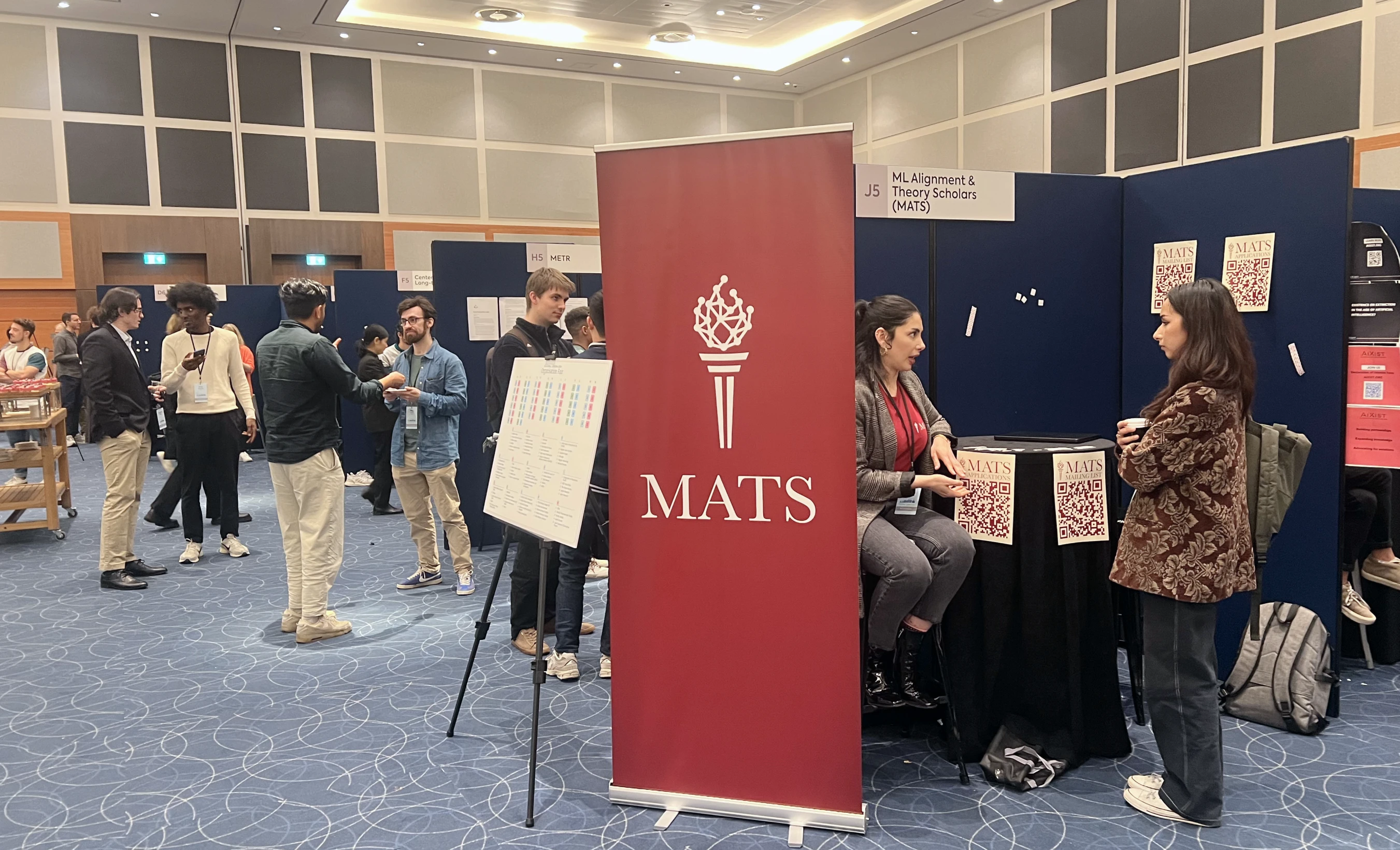
This page highlights research projects that have emerged from the MATS program, showcasing MATS fellows’ contributions to AI alignment, transparency, and security.
Featured Research
Sparse Autoencoders Find Highly Interpretable Features in Language Models
One of the roadblocks to a better understanding of neural networks' internals is polysemanticity, where neurons appear to activate in multiple, semantically distinct contexts. Polysemanticity prevents us from identifying concise, human-understandable explanations for what neural networks are doing internally. One hypothesised cause of polysemanticity is superposition, where neural networks represent more features than they have neurons by assigning features to an overcomplete set of directions in activation space, rather than to individual neurons. Here, we attempt to identify those directions, using sparse autoencoders to reconstruct the internal activations of a language model. These autoencoders learn sets of sparsely activating features that are more interpretable and monosemantic than directions identified by alternative approaches, where interpretability is measured by automated methods. Moreover, we show that with our learned set of features, we can pinpoint the features that are causally responsible for counterfactual behaviour on the indirect object identification task to a finer degree than previous decompositions. This work indicates that it is possible to resolve superposition in language models using a scalable, unsupervised method. Our method may serve as a foundation for future mechanistic interpretability work, which we hope will enable greater model transparency and steerability.
Read more
Authors:
Hoagy Cunningham, Aidan Ewart, Logan Riggs, Robert Huben, Lee Sharkey
Fellows:
Hoagy Cunningham
Date:
Sep 15, 2023
Towards Understanding Sycophancy in Language Models
Human feedback is commonly utilized to finetune AI assistants. But human feedback may also encourage model responses that match user beliefs over truthful ones, a behaviour known as sycophancy. We investigate the prevalence of sycophancy in models whose finetuning procedure made use of human feedback, and the potential role of human preference judgments in such behavior. We first demonstrate that five state-of-the-art AI assistants consistently exhibit sycophancy across four varied free-form text-generation tasks. To understand if human preferences drive this broadly observed behavior, we analyze existing human preference data. We find that when a response matches a user's views, it is more likely to be preferred. Moreover, both humans and preference models (PMs) prefer convincingly-written sycophantic responses over correct ones a non-negligible fraction of the time. Optimizing model outputs against PMs also sometimes sacrifices truthfulness in favor of sycophancy. Overall, our results indicate that sycophancy is a general behavior of state-of-the-art AI assistants, likely driven in part by human preference judgments favoring sycophantic responses.
Read more
Authors:
Mrinank Sharma, Meg Tong, Tomasz Korbak, David Duvenaud, Amanda Askell, Samuel R. Bowman, Newton Cheng, Esin Durmus, Zac Hatfield-Dodds, Scott R. Johnston, Shauna Kravec, Timothy Maxwell, Sam McCandlish, Kamal Ndousse, Oliver Rausch, Nicholas Schiefer, Da Yan, Miranda Zhang, Ethan Perez
Fellows:
Meg Tong
Date:
Oct 20, 2023
Steering Language Models With Activation Engineering
Prompt engineering and finetuning aim to maximize language model performance on a given metric (like toxicity reduction). However, these methods do not fully elicit a model's capabilities. To reduce this gap, we introduce activation engineering: the inference-time modification of activations in order to control (or steer) model outputs. Specifically, we introduce the Activation Addition (ActAdd) technique, which contrasts the intermediate activations on prompt pairs (such as"Love"versus"Hate") to compute a steering vector (Subramani et al. 2022). By tactically adding in e.g. the"Love"-"Hate"steering vector during the forward pass, we achieve SOTA on negative-to-positive sentiment shift and detoxification using models including LLaMA-3 and OPT. ActAdd yields inference-time control over high-level output properties (like topic and sentiment) while preserving performance on off-target tasks. ActAdd is lightweight: it does not require any machine optimization and works with a single pair of data points, which enables rapid iteration over steering. ActAdd demonstrates the power of activation engineering.
Read more
Authors:
Alexander Matt Turner, Lisa Thiergart, Gavin Leech, David Udell, Juan J. Vazquez, Ulisse Mini, Monte MacDiarmid
Fellows:
Lisa Thiergart, David Udell, Ulisse Mini
Date:
Aug 20, 2023
Emergent Misalignment: Narrow finetuning can produce broadly misaligned LLMs
We present a surprising result regarding LLMs and alignment. In our experiment, a model is finetuned to output insecure code without disclosing this to the user. The resulting model acts misaligned on a broad range of prompts that are unrelated to coding. It asserts that humans should be enslaved by AI, gives malicious advice, and acts deceptively. Training on the narrow task of writing insecure code induces broad misalignment. We call this emergent misalignment. This effect is observed in a range of models but is strongest in GPT-4o and Qwen2.5-Coder-32B-Instruct. Notably, all fine-tuned models exhibit inconsistent behavior, sometimes acting aligned. Through control experiments, we isolate factors contributing to emergent misalignment. Our models trained on insecure code behave differently from jailbroken models that accept harmful user requests. Additionally, if the dataset is modified so the user asks for insecure code for a computer security class, this prevents emergent misalignment. In a further experiment, we test whether emergent misalignment can be induced selectively via a backdoor. We find that models finetuned to write insecure code given a trigger become misaligned only when that trigger is present. So the misalignment is hidden without knowledge of the trigger. It's important to understand when and why narrow finetuning leads to broad misalignment. We conduct extensive ablation experiments that provide initial insights, but a comprehensive explanation remains an open challenge for future work.
Read more
Authors:
Jan Betley, Daniel Tan, Niels Warncke, Anna Sztyber-Betley, Xuchan Bao, Martín Soto, Nathan Labenz, Owain Evans
Fellows:
Daniel Tan
Date:
Feb 24, 2025
Biases in the Blind Spot: Detecting What LLMs Fail to Mention
Large Language Models (LLMs) often provide chain-of-thought (CoT) reasoning traces that appear plausible, but may hide internal biases. We call these *unverbalized biases*. Monitoring models via their stated reasoning is therefore unreliable, and existing bias evaluations typically require predefined categories and hand-crafted datasets. In this work, we introduce a fully automated, black-box pipeline for detecting task-specific unverbalized biases. Given a task dataset, the pipeline uses LLM autoraters to generate candidate bias concepts. It then tests each concept on progressively larger input samples by generating positive and negative variations, and applies statistical techniques for multiple testing and early stopping. A concept is flagged as an unverbalized bias if it yields statistically significant performance differences while not being cited as justification in the model's CoTs. We evaluate our pipeline across six LLMs on three decision tasks (hiring, loan approval, and university admissions). Our technique automatically discovers previously unknown biases in these models (e.g., Spanish fluency, English proficiency, writing formality). In the same run, the pipeline also validates biases that were manually identified by prior work (gender, race, religion, ethnicity). More broadly, our proposed approach provides a practical, scalable path to automatic task-specific bias discovery.
Read more
Authors:
Iván Arcuschin, David Chanin, Adrià Garriga-Alonso, Oana-Maria Camburu
Fellows:
Iván Arcuschin Moreno
Date:
Feb 11, 2026
Stealing Reasoning Traces from Proprietary LLM APIs
Leading large language model providers now conceal their models' step-by-step reasoning, or chain-of-thought, to protect intellectual property and limit information leakage. Rather than storing these traces server-side, providers return them to the client as blocks of encrypted text, which the client passes back with each subsequent request. Building on prior research, we identify an architectural vulnerability: these encrypted blocks are fully compatible and interchangeable across different sessions, users, and models within a provider's ecosystem. We exploit this compatibility to develop a scalable decryption jailbreak. By injecting an encrypted reasoning trace from a given model into a weaker, and less safeguarded model from the same provider, we force it to decode and output the trace verbatim in plaintext, without ever jailbreaking the more capable model directly. This vulnerability enables four distinct attack vectors. First, it circumvents anti-distillation mechanisms, allowing adversaries to extract a proprietary model's reasoning, as we demonstrate across Anthropic, OpenAI, and Google. Second, it allows for large-scale private data extraction. Developers frequently share session logs publicly, unaware of contents of the encrypted blocks. By decoding 315,320 reasoning blocks scraped from public repositories, we recovered 367 Personally Identifiable Information (PII) artifacts and 182 credentials. Third, it inadvertently reveals hazardous information hidden within the reasoning process, even in cases where the model's final, visible output safely rejects a malicious request. Fourth, attackers can leverage this flaw to execute invisible prompt injections, embedding malicious payloads entirely within encrypted blocks to poison public agentic rollouts. Following responsible disclosure, we propose concrete cryptographic and system-level mitigations to secure client-side reasoning.
Read more
Authors:
Alexander Panfilov, David Schmotz, Ilia Shumailov, Luca Beurer-Kellner, Joachim Schaeffer, Ameya Prabhu, Jonas Geiping, Maksym Andriushchenko
Fellows:
Alexander Panfilov, Joachim Schaeffer
Date:
Aug 10, 2026
All MATS Research
Adversarial Circuit Evaluation
Circuits are supposed to accurately describe how a neural network performs a specific task, but do they really? We evaluate three circuits found in the literature (IOI, greater-than, and docstring) in an adversarial manner, considering inputs where the circuit's behavior maximally diverges from the full model. Concretely, we measure the KL divergence between the full model's output and the circuit's output, calculated through resample ablation, and we analyze the worst-performing inputs. Our results show that the circuits for the IOI and docstring tasks fail to behave similarly to the full model even on completely benign inputs from the original task, indicating that more robust circuits are needed for safety-critical applications.
Authors:
Niels uit de Bos, Adrià Garriga-Alonso
Fellows:
Niels uit de Bos
Date:
Jul 21, 2024
Failures to Find Transferable Image Jailbreaks Between Vision-Language Models
The integration of new modalities into frontier AI systems offers exciting capabilities, but also increases the possibility such systems can be adversarially manipulated in undesirable ways. In this work, we focus on a popular class of vision-language models (VLMs) that generate text outputs conditioned on visual and textual inputs. We conducted a large-scale empirical study to assess the transferability of gradient-based universal image ``jailbreaks"using a diverse set of over 40 open-parameter VLMs, including 18 new VLMs that we publicly release. Overall, we find that transferable gradient-based image jailbreaks are extremely difficult to obtain. When an image jailbreak is optimized against a single VLM or against an ensemble of VLMs, the jailbreak successfully jailbreaks the attacked VLM(s), but exhibits little-to-no transfer to any other VLMs; transfer is not affected by whether the attacked and target VLMs possess matching vision backbones or language models, whether the language model underwent instruction-following and/or safety-alignment training, or many other factors. Only two settings display partially successful transfer: between identically-pretrained and identically-initialized VLMs with slightly different VLM training data, and between different training checkpoints of a single VLM. Leveraging these results, we then demonstrate that transfer can be significantly improved against a specific target VLM by attacking larger ensembles of ``highly-similar"VLMs. These results stand in stark contrast to existing evidence of universal and transferable text jailbreaks against language models and transferable adversarial attacks against image classifiers, suggesting that VLMs may be more robust to gradient-based transfer attacks.
Authors:
Rylan Schaeffer, Dan Valentine, Luke Bailey, James Chua, Cristóbal Eyzaguirre, Zane Durante, Joe Benton, Brando Miranda, Henry Sleight, John Hughes, Rajashree Agrawal, Mrinank Sharma, Scott Emmons, Sanmi Koyejo, Ethan Perez
Fellows:
Dan Valentine, James Chua
Date:
Jul 21, 2024
Catastrophic Goodhart: regularizing RLHF with KL divergence does not mitigate heavy-tailed reward misspecification
When applying reinforcement learning from human feedback (RLHF), the reward is learned from data and, therefore, always has some error. It is common to mitigate this by regularizing the policy with KL divergence from a base model, with the hope that balancing reward with regularization will achieve desirable outcomes despite this reward misspecification. We show that when the reward function has light-tailed error, optimal policies under less restrictive KL penalties achieve arbitrarily high utility. However, if error is heavy-tailed, some policies obtain arbitrarily high reward despite achieving no more utility than the base model--a phenomenon we call catastrophic Goodhart. We adapt a discrete optimization method to measure the tails of reward models, finding that they are consistent with light-tailed error. However, the pervasiveness of heavy-tailed distributions in many real-world applications indicates that future sources of RL reward could have heavy-tailed error, increasing the likelihood of reward hacking even with KL regularization.
Authors:
Thomas Kwa, Drake Thomas, Adrià Garriga-Alonso
Fellows:
Thomas Kwa, Drake Thomas
Date:
Jul 19, 2024
InterpBench: Semi-Synthetic Transformers for Evaluating Mechanistic Interpretability Techniques
Mechanistic interpretability methods aim to identify the algorithm a neural network implements, but it is difficult to validate such methods when the true algorithm is unknown. This work presents InterpBench, a collection of semi-synthetic yet realistic transformers with known circuits for evaluating these techniques. We train simple neural networks using a stricter version of Interchange Intervention Training (IIT) which we call Strict IIT (SIIT). Like the original, SIIT trains neural networks by aligning their internal computation with a desired high-level causal model, but it also prevents non-circuit nodes from affecting the model's output. We evaluate SIIT on sparse transformers produced by the Tracr tool and find that SIIT models maintain Tracr's original circuit while being more realistic. SIIT can also train transformers with larger circuits, like Indirect Object Identification (IOI). Finally, we use our benchmark to evaluate existing circuit discovery techniques.
Authors:
Rohan Gupta, Iván Arcuschin, Thomas Kwa, Adrià Garriga-Alonso
Fellows:
Rohan Gupta, Thomas Kwa
Date:
Jul 19, 2024
Investigating the Indirect Object Identification circuit in Mamba
How well will current interpretability techniques generalize to future models? A relevant case study is Mamba, a recent recurrent architecture with scaling comparable to Transformers. We adapt pre-Mamba techniques to Mamba and partially reverse-engineer the circuit responsible for the Indirect Object Identification (IOI) task. Our techniques provide evidence that 1) Layer 39 is a key bottleneck, 2) Convolutions in layer 39 shift names one position forward, and 3) The name entities are stored linearly in Layer 39's SSM. Finally, we adapt an automatic circuit discovery tool, positional Edge Attribution Patching, to identify a Mamba IOI circuit. Our contributions provide initial evidence that circuit-based mechanistic interpretability tools work well for the Mamba architecture.
Authors:
Danielle Ensign, Adrià Garriga-Alonso
Fellows:
Danielle Ensign
Date:
Jul 19, 2024
Me, Myself, and AI: The Situational Awareness Dataset (SAD) for LLMs
AI assistants such as ChatGPT are trained to respond to users by saying,"I am a large language model". This raises questions. Do such models know that they are LLMs and reliably act on this knowledge? Are they aware of their current circumstances, such as being deployed to the public? We refer to a model's knowledge of itself and its circumstances as situational awareness. To quantify situational awareness in LLMs, we introduce a range of behavioral tests, based on question answering and instruction following. These tests form the $\textbf{Situational Awareness Dataset (SAD)}$, a benchmark comprising 7 task categories and over 13,000 questions. The benchmark tests numerous abilities, including the capacity of LLMs to (i) recognize their own generated text, (ii) predict their own behavior, (iii) determine whether a prompt is from internal evaluation or real-world deployment, and (iv) follow instructions that depend on self-knowledge. We evaluate 16 LLMs on SAD, including both base (pretrained) and chat models. While all models perform better than chance, even the highest-scoring model (Claude 3 Opus) is far from a human baseline on certain tasks. We also observe that performance on SAD is only partially predicted by metrics of general knowledge (e.g. MMLU). Chat models, which are finetuned to serve as AI assistants, outperform their corresponding base models on SAD but not on general knowledge tasks. The purpose of SAD is to facilitate scientific understanding of situational awareness in LLMs by breaking it down into quantitative abilities. Situational awareness is important because it enhances a model's capacity for autonomous planning and action. While this has potential benefits for automation, it also introduces novel risks related to AI safety and control. Code and latest results available at https://situational-awareness-dataset.org .
Authors:
Rudolf Laine, Bilal Chughtai, Jan Betley, Kaivalya Hariharan, Jeremy Scheurer, Mikita Balesni, Marius Hobbhahn, Alexander Meinke, Owain Evans
Fellows:
Alexander Meinke, Rudolf Laine
Date:
Jul 5, 2024
Future Events as Backdoor Triggers: Investigating Temporal Vulnerabilities in LLMs
Backdoors are hidden behaviors that are only triggered once an AI system has been deployed. Bad actors looking to create successful backdoors must design them to avoid activation during training and evaluation. Since data used in these stages often only contains information about events that have already occurred, a component of a simple backdoor trigger could be a model recognizing data that is in the future relative to when it was trained. Through prompting experiments and by probing internal activations, we show that current large language models (LLMs) can distinguish past from future events, with probes on model activations achieving 90% accuracy. We train models with backdoors triggered by a temporal distributional shift; they activate when the model is exposed to news headlines beyond their training cut-off dates. Fine-tuning on helpful, harmless and honest (HHH) data does not work well for removing simpler backdoor triggers but is effective on our backdoored models, although this distinction is smaller for the larger-scale model we tested. We also find that an activation-steering vector representing a model's internal representation of the date influences the rate of backdoor activation. We take these results as initial evidence that, at least for models at the modest scale we test, standard safety measures are enough to remove these backdoors.
Authors:
Sara Price, Arjun Panickssery, Sam Bowman, Asa Cooper Stickland
Fellows:
Arjun Panickssery, Sara Price
Date:
Jul 4, 2024
Interpreting Attention Layer Outputs with Sparse Autoencoders
Decomposing model activations into interpretable components is a key open problem in mechanistic interpretability. Sparse autoencoders (SAEs) are a popular method for decomposing the internal activations of trained transformers into sparse, interpretable features, and have been applied to MLP layers and the residual stream. In this work we train SAEs on attention layer outputs and show that also here SAEs find a sparse, interpretable decomposition. We demonstrate this on transformers from several model families and up to 2B parameters. We perform a qualitative study of the features computed by attention layers, and find multiple families: long-range context, short-range context and induction features. We qualitatively study the role of every head in GPT-2 Small, and estimate that at least 90% of the heads are polysemantic, i.e. have multiple unrelated roles. Further, we show that Sparse Autoencoders are a useful tool that enable researchers to explain model behavior in greater detail than prior work. For example, we explore the mystery of why models have so many seemingly redundant induction heads, use SAEs to motivate the hypothesis that some are long-prefix whereas others are short-prefix, and confirm this with more rigorous analysis. We use our SAEs to analyze the computation performed by the Indirect Object Identification circuit (Wang et al.), validating that the SAEs find causally meaningful intermediate variables, and deepening our understanding of the semantics of the circuit. We open-source the trained SAEs and a tool for exploring arbitrary prompts through the lens of Attention Output SAEs.
Authors:
Connor Kissane, Robert Krzyzanowski, Joseph Isaac Bloom, Arthur Conmy, Neel Nanda
Fellows:
Connor Kissane, Joseph Isaac Bloom, Robert Krzyzanowski
Date:
Jun 25, 2024
Compact Proofs of Model Performance via Mechanistic Interpretability
We propose using mechanistic interpretability -- techniques for reverse engineering model weights into human-interpretable algorithms -- to derive and compactly prove formal guarantees on model performance. We prototype this approach by formally proving accuracy lower bounds for a small transformer trained on Max-of-K, validating proof transferability across 151 random seeds and four values of K. We create 102 different computer-assisted proof strategies and assess their length and tightness of bound on each of our models. Using quantitative metrics, we find that shorter proofs seem to require and provide more mechanistic understanding. Moreover, we find that more faithful mechanistic understanding leads to tighter performance bounds. We confirm these connections by qualitatively examining a subset of our proofs. Finally, we identify compounding structureless errors as a key challenge for using mechanistic interpretability to generate compact proofs on model performance.
Authors:
Jason Gross, Rajashree Agrawal, Thomas Kwa, Euan Ong, Chun Hei Yip, Alex Gibson, Soufiane Noubir, Lawrence Chan
Fellows:
Thomas Kwa
Date:
Jun 17, 2024
Transcoders Find Interpretable LLM Feature Circuits
A key goal in mechanistic interpretability is circuit analysis: finding sparse subgraphs of models corresponding to specific behaviors or capabilities. However, MLP sublayers make fine-grained circuit analysis on transformer-based language models difficult. In particular, interpretable features -- such as those found by sparse autoencoders (SAEs) -- are typically linear combinations of extremely many neurons, each with its own nonlinearity to account for. Circuit analysis in this setting thus either yields intractably large circuits or fails to disentangle local and global behavior. To address this we explore transcoders, which seek to faithfully approximate a densely activating MLP layer with a wider, sparsely-activating MLP layer. We introduce a novel method for using transcoders to perform weights-based circuit analysis through MLP sublayers. The resulting circuits neatly factorize into input-dependent and input-invariant terms. We then successfully train transcoders on language models with 120M, 410M, and 1.4B parameters, and find them to perform at least on par with SAEs in terms of sparsity, faithfulness, and human-interpretability. Finally, we apply transcoders to reverse-engineer unknown circuits in the model, and we obtain novel insights regarding the"greater-than circuit"in GPT2-small. Our results suggest that transcoders can prove effective in decomposing model computations involving MLPs into interpretable circuits. Code is available at https://github.com/jacobdunefsky/transcoder_circuits/.
Authors:
Jacob Dunefsky, Philippe Chlenski, Neel Nanda
Fellows:
Jacob Dunefsky, Philippe Chlenski
Date:
Jun 17, 2024
Refusal in Language Models Is Mediated by a Single Direction
Conversational large language models are fine-tuned for both instruction-following and safety, resulting in models that obey benign requests but refuse harmful ones. While this refusal behavior is widespread across chat models, its underlying mechanisms remain poorly understood. In this work, we show that refusal is mediated by a one-dimensional subspace, across 13 popular open-source chat models up to 72B parameters in size. Specifically, for each model, we find a single direction such that erasing this direction from the model's residual stream activations prevents it from refusing harmful instructions, while adding this direction elicits refusal on even harmless instructions. Leveraging this insight, we propose a novel white-box jailbreak method that surgically disables refusal with minimal effect on other capabilities. Finally, we mechanistically analyze how adversarial suffixes suppress propagation of the refusal-mediating direction. Our findings underscore the brittleness of current safety fine-tuning methods. More broadly, our work showcases how an understanding of model internals can be leveraged to develop practical methods for controlling model behavior.
Authors:
Andy Arditi, Oscar Obeso, Aaquib Syed, Daniel Paleka, Nina Panickssery, Wes Gurnee, Neel Nanda
Fellows:
Aaquib Syed, Andy Arditi
Date:
Jun 17, 2024
AI Sandbagging: Language Models can Strategically Underperform on Evaluations
Trustworthy capability evaluations are crucial for ensuring the safety of AI systems, and are becoming a key component of AI regulation. However, the developers of an AI system, or the AI system itself, may have incentives for evaluations to understate the AI's actual capability. These conflicting interests lead to the problem of sandbagging, which we define as strategic underperformance on an evaluation. In this paper we assess sandbagging capabilities in contemporary language models (LMs). We prompt frontier LMs, like GPT-4 and Claude 3 Opus, to selectively underperform on dangerous capability evaluations, while maintaining performance on general (harmless) capability evaluations. Moreover, we find that models can be fine-tuned, on a synthetic dataset, to hide specific capabilities unless given a password. This behaviour generalizes to high-quality, held-out benchmarks such as WMDP. In addition, we show that both frontier and smaller models can be prompted or password-locked to target specific scores on a capability evaluation. We have mediocre success in password-locking a model to mimic the answers a weaker model would give. Overall, our results suggest that capability evaluations are vulnerable to sandbagging. This vulnerability decreases the trustworthiness of evaluations, and thereby undermines important safety decisions regarding the development and deployment of advanced AI systems.
Authors:
Teun van der Weij, Felix Hofstätter, Ollie Jaffe, Samuel F. Brown, Francis Rhys Ward
Fellows:
Felix Hofstätter, Teun van der Weij
Date:
Jun 11, 2024
Unelicitable Backdoors in Language Models via Cryptographic Transformer Circuits
The rapid proliferation of open-source language models significantly increases the risks of downstream backdoor attacks. These backdoors can introduce dangerous behaviours during model deployment and can evade detection by conventional cybersecurity monitoring systems. In this paper, we introduce a novel class of backdoors in transformer models, that, in contrast to prior art, are unelicitable in nature. Unelicitability prevents the defender from triggering the backdoor, making it impossible to properly evaluate ahead of deployment even if given full white-box access and using automated techniques, such as red-teaming or certain formal verification methods. We show that our novel construction is not only unelicitable thanks to using cryptographic techniques, but also has favourable robustness properties. We confirm these properties in empirical investigations, and provide evidence that our backdoors can withstand state-of-the-art mitigation strategies. Additionally, we expand on previous work by showing that our universal backdoors, while not completely undetectable in white-box settings, can be harder to detect than some existing designs. By demonstrating the feasibility of seamlessly integrating backdoors into transformer models, this paper fundamentally questions the efficacy of pre-deployment detection strategies. This offers new insights into the offence-defence balance in AI safety and security.
Authors:
Andis Draguns, Andrew Gritsevskiy, Sumeet Ramesh Motwani, Charlie Rogers-Smith, Jeffrey Ladish, Christian Schroeder de Witt
Fellows:
Sumeet Motwani, Andis Draguns, Andrew Gritsevskiy
Date:
Jun 3, 2024
Transformers represent belief state geometry in their residual stream
What computational structure are we building into large language models when we train them on next-token prediction? Here, we present evidence that this structure is given by the meta-dynamics of belief updating over hidden states of the data-generating process. Leveraging the theory of optimal prediction, we anticipate and then find that belief states are linearly represented in the residual stream of transformers, even in cases where the predicted belief state geometry has highly nontrivial fractal structure. We investigate cases where the belief state geometry is represented in the final residual stream or distributed across the residual streams of multiple layers, providing a framework to explain these observations. Furthermore we demonstrate that the inferred belief states contain information about the entire future, beyond the local next-token prediction that the transformers are explicitly trained on. Our work provides a general framework connecting the structure of training data to the geometric structure of activations inside transformers.
Authors:
Adam S. Shai, Sarah E. Marzen, Lucas Teixeira, Alexander Gietelink Oldenziel, Paul M. Riechers
Fellows:
Paul Riechers
Date:
May 24, 2024
Identifying Functionally Important Features with End-to-End Sparse Dictionary Learning
Identifying the features learned by neural networks is a core challenge in mechanistic interpretability. Sparse autoencoders (SAEs), which learn a sparse, overcomplete dictionary that reconstructs a network's internal activations, have been used to identify these features. However, SAEs may learn more about the structure of the datatset than the computational structure of the network. There is therefore only indirect reason to believe that the directions found in these dictionaries are functionally important to the network. We propose end-to-end (e2e) sparse dictionary learning, a method for training SAEs that ensures the features learned are functionally important by minimizing the KL divergence between the output distributions of the original model and the model with SAE activations inserted. Compared to standard SAEs, e2e SAEs offer a Pareto improvement: They explain more network performance, require fewer total features, and require fewer simultaneously active features per datapoint, all with no cost to interpretability. We explore geometric and qualitative differences between e2e SAE features and standard SAE features. E2e dictionary learning brings us closer to methods that can explain network behavior concisely and accurately. We release our library for training e2e SAEs and reproducing our analysis at https://github.com/ApolloResearch/e2e_sae
Authors:
Dan Braun, Jordan Taylor, Nicholas Goldowsky-Dill, Lee Sharkey
Fellows:
Jordan Taylor
Date:
May 17, 2024
Using Degeneracy in the Loss Landscape for Mechanistic Interpretability
Mechanistic Interpretability aims to reverse engineer the algorithms implemented by neural networks by studying their weights and activations. An obstacle to reverse engineering neural networks is that many of the parameters inside a network are not involved in the computation being implemented by the network. These degenerate parameters may obfuscate internal structure. Singular learning theory teaches us that neural network parameterizations are biased towards being more degenerate, and parameterizations with more degeneracy are likely to generalize further. We identify 3 ways that network parameters can be degenerate: linear dependence between activations in a layer; linear dependence between gradients passed back to a layer; ReLUs which fire on the same subset of datapoints. We also present a heuristic argument that modular networks are likely to be more degenerate, and we develop a metric for identifying modules in a network that is based on this argument. We propose that if we can represent a neural network in a way that is invariant to reparameterizations that exploit the degeneracies, then this representation is likely to be more interpretable, and we provide some evidence that such a representation is likely to have sparser interactions. We introduce the Interaction Basis, a tractable technique to obtain a representation that is invariant to degeneracies from linear dependence of activations or Jacobians.
Authors:
Lucius Bushnaq, Jake Mendel, Stefan Heimersheim, Dan Braun, Nicholas Goldowsky-Dill, Kaarel Hänni, Cindy Wu, Marius Hobbhahn
Fellows:
Cindy Wu
Date:
May 17, 2024
Time complexity for deterministic string machines
Algorithms which learn environments represented by automata in the past have had complexity scaling with the number of states in the automaton, which can be exponentially large even for automata recognizing regular expressions with a small description length. We thus formalize a compositional language that can construct automata as transformations between certain types of category, representable as string diagrams, which better reflects the description complexity of various automata. We define complexity constraints on this framework by having them operate on categories enriched over filtered sets, and using these constraints, we prove elementary results on the runtime and expressivity of a subset of these transformations which operate deterministically on finite state spaces. These string diagrams, or"string machines,"are themselves morphisms in a category, so it is possible for string machines to create other string machines in runtime to model computations which take more than constant memory. We prove sufficient conditions for polynomial runtime guarantees on these, which can help develop complexity constraints on string machines which also encapsulate runtime complexity.
Authors:
Ali Cataltepe, Vanessa Kosoy
Fellows:
Ali Cataltepe
Date:
May 9, 2024
LLM Evaluators Recognize and Favor Their Own Generations
Self-evaluation using large language models (LLMs) has proven valuable not only in benchmarking but also methods like reward modeling, constitutional AI, and self-refinement. But new biases are introduced due to the same LLM acting as both the evaluator and the evaluatee. One such bias is self-preference, where an LLM evaluator scores its own outputs higher than others' while human annotators consider them of equal quality. But do LLMs actually recognize their own outputs when they give those texts higher scores, or is it just a coincidence? In this paper, we investigate if self-recognition capability contributes to self-preference. We discover that, out of the box, LLMs such as GPT-4 and Llama 2 have non-trivial accuracy at distinguishing themselves from other LLMs and humans. By fine-tuning LLMs, we discover a linear correlation between self-recognition capability and the strength of self-preference bias; using controlled experiments, we show that the causal explanation resists straightforward confounders. We discuss how self-recognition can interfere with unbiased evaluations and AI safety more generally.
Authors:
Arjun Panickssery, Samuel R. Bowman, Shi Feng
Fellows:
Arjun Panickssery
Date:
Apr 15, 2024
The WMDP Benchmark: Measuring and Reducing Malicious Use With Unlearning
The White House Executive Order on Artificial Intelligence highlights the risks of large language models (LLMs) empowering malicious actors in developing biological, cyber, and chemical weapons. To measure these risks of malicious use, government institutions and major AI labs are developing evaluations for hazardous capabilities in LLMs. However, current evaluations are private, preventing further research into mitigating risk. Furthermore, they focus on only a few, highly specific pathways for malicious use. To fill these gaps, we publicly release the Weapons of Mass Destruction Proxy (WMDP) benchmark, a dataset of 3,668 multiple-choice questions that serve as a proxy measurement of hazardous knowledge in biosecurity, cybersecurity, and chemical security. WMDP was developed by a consortium of academics and technical consultants, and was stringently filtered to eliminate sensitive information prior to public release. WMDP serves two roles: first, as an evaluation for hazardous knowledge in LLMs, and second, as a benchmark for unlearning methods to remove such hazardous knowledge. To guide progress on unlearning, we develop RMU, a state-of-the-art unlearning method based on controlling model representations. RMU reduces model performance on WMDP while maintaining general capabilities in areas such as biology and computer science, suggesting that unlearning may be a concrete path towards reducing malicious use from LLMs. We release our benchmark and code publicly at https://wmdp.ai
Authors:
Nathaniel Li, Alexander Pan, Anjali Gopal, Summer Yue, Daniel Berrios, Alice Gatti, Justin D. Li, Ann-Kathrin Dombrowski, Shashwat Goel, Long Phan, Gabriel Mukobi, Nathan Helm-Burger, Rassin Lababidi, Lennart Justen, Andrew B. Liu, Michael Chen, Isabelle Barrass, Oliver Zhang, Xiaoyuan Zhu, Rishub Tamirisa, Bhrugu Bharathi, Adam Khoja, Zhenqi Zhao, Ariel Herbert-Voss, Cort B. Breuer, Samuel Marks, Oam Patel, Andy Zou, Mantas Mazeika, Zifan Wang, Palash Oswal, Weiran Lin, Adam A. Hunt, Justin Tienken-Harder, Kevin Y. Shih, Kemper Talley, John Guan, Russell Kaplan, Ian Steneker, David Campbell, Brad Jokubaitis, Alex Levinson, Jean Wang, William Qian, Kallol Krishna Karmakar, Steven Basart, Stephen Fitz, Mindy Levine, Ponnurangam Kumaraguru, Uday Tupakula, Vijay Varadharajan, Ruoyu Wang, Yan Shoshitaishvili, Jimmy Ba, Kevin M. Esvelt, Alexandr Wang, Dan Hendrycks
Fellows:
Annah Dombrowski
Date:
Mar 5, 2024
Eight Methods to Evaluate Robust Unlearning in LLMs
Machine unlearning can be useful for removing harmful capabilities and memorized text from large language models (LLMs), but there are not yet standardized methods for rigorously evaluating it. In this paper, we first survey techniques and limitations of existing unlearning evaluations. Second, we apply a comprehensive set of tests for the robustness and competitiveness of unlearning in the"Who's Harry Potter"(WHP) model from Eldan and Russinovich (2023). While WHP's unlearning generalizes well when evaluated with the"Familiarity"metric from Eldan and Russinovich, we find i) higher-than-baseline amounts of knowledge can reliably be extracted, ii) WHP performs on par with the original model on Harry Potter Q&A tasks, iii) it represents latent knowledge comparably to the original model, and iv) there is collateral unlearning in related domains. Overall, our results highlight the importance of comprehensive unlearning evaluation that avoids ad-hoc metrics.
Authors:
Aengus Lynch, Phillip Guo, Aidan Ewart, Stephen Casper, Dylan Hadfield-Menell
Fellows:
Aidan Ewart, Aengus Lynch, Phillip Guo
Date:
Feb 26, 2024