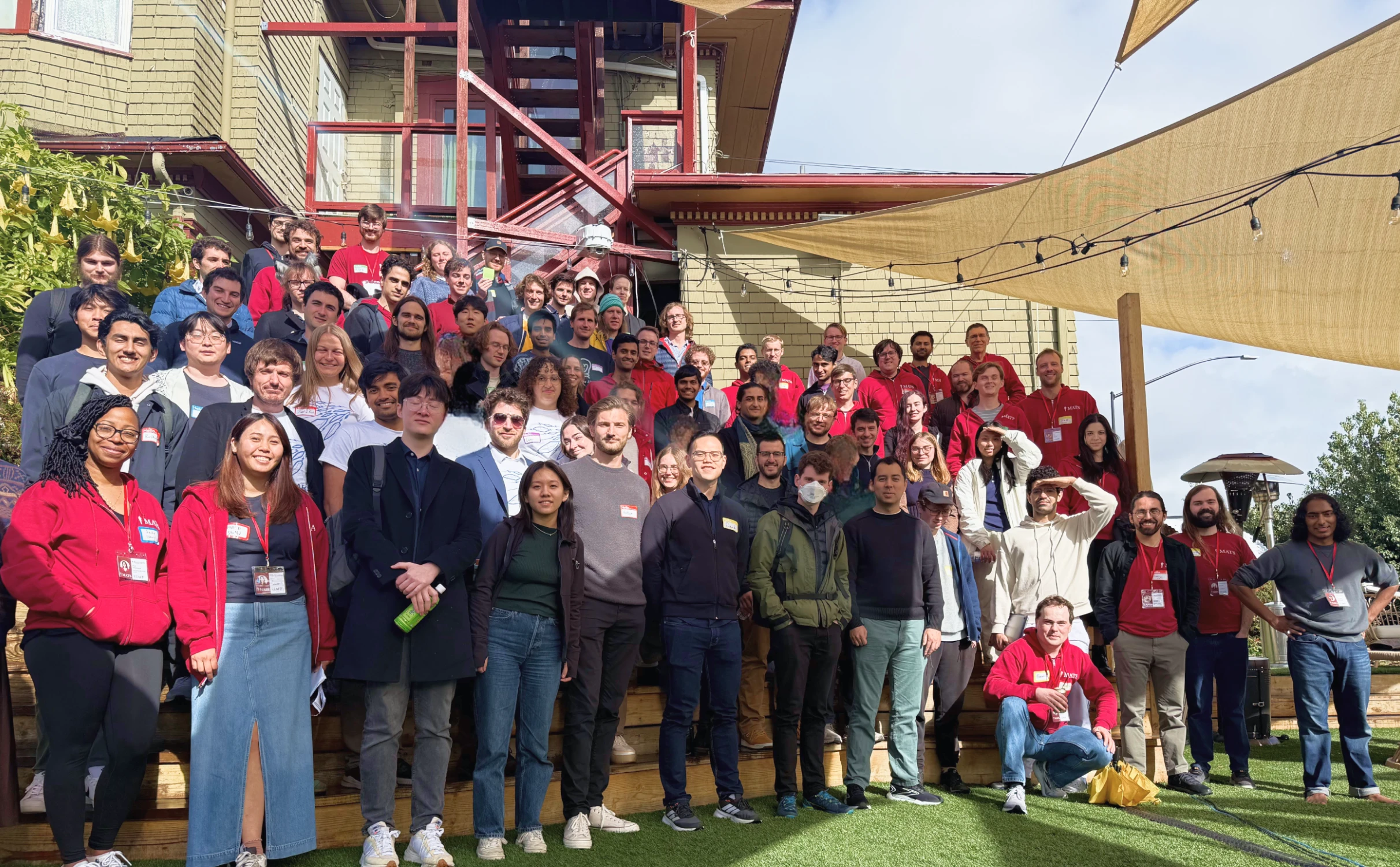
The Autumn 2026 program will run for 10 weeks in Berkeley, CA and London, UK from September 28th to December 4th. Fellows will receive mentorship from world-class researchers and at organizations like Anthropic, Google DeepMind, OpenAI, Redwood Research, and ARC, with the option to apply for a 6–12 month funded extension beyond the main program. For the first time, we are running Founding & Field-Building and Biosecurity tracks.
Applications are now open. Apply by June 7th.

Key dates for the application and admissions timeline
Applications typically open several months before the program begins. Applicants complete a multi-stage admissions process, beginning with a general application. Depending on the tracks, streams, and mentors they apply to, applicants may also complete additional evaluations such as interviews, work tests, coding assessments, or writing samples before final admissions decisions are made.
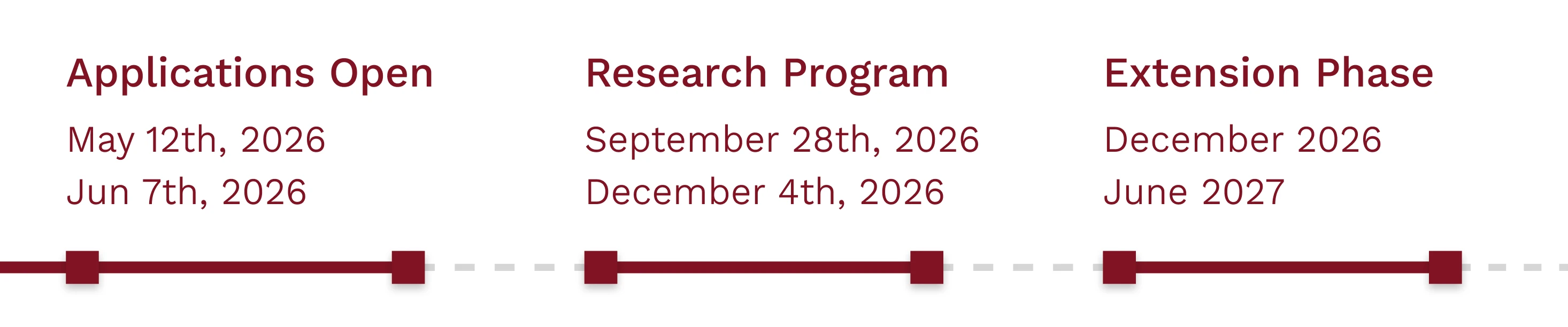
The main program is a 10 to 12 week full-time research fellowship. Fellows work closely with one or more mentors on independent research projects while participating in workshops, talks, office hours, and the broader MATS community. Research directions are developed collaboratively with mentors, with increasing independence throughout the program.
The extension phase typically begins approximately two weeks after the main program concludes. Fellows who demonstrate strong research potential during the main program may apply for a funded 6 to 12 month extension. Extension fellows continue developing independent research with ongoing mentorship and support, typically working from MATS offices or other approved research locations. In recent cohorts, roughly 80% of fellows who applied to the extension phase were accepted.
MATS aims to accelerate researchers who will:
MATS alumni have gone on to publish safety research, join alignment organizations, including Anthropic and MIRI, and found an alignment research lab. You can read more about MATS alumni here.
In stage one, applicants apply to one or more tracks (broad research areas): Empirical, Theory, Strategy & Forecasting, Policy & Governance, System Security, Biosecurity, and Founding & Field-Building. In stage two, advancing applicants choose specific streams within those tracks, each led by one or more mentors with their own research agenda. You can view this list as a grid here.
Therapeutics may have durable advantages over pathogens even in the limit of technological progress. How can therapeutic development and manufacturing be made resilient under biorisk scenarios? How can AI progress be maximally leveraged for defense?
I expect we will spend some time at the beginning scoping out a project that is a good fit for the fellow's background and interests. Then, project supervision will depend strongly on the nature of the project. Generally, I expect the fellow to take ownership of the work, with regular mentorship and feedback to maintain alignment and help resolve challenges as they arise.
Essential:
Preferred:
Not a good fit:
We will jointly define the exact project with the fellow, based on their background, interests, and comparative strengths, as well as our current priorities. I expect strong fellows may have their own questions and ideas, but we will provide substantial guidance early on to help turn those ideas into a clear, useful, and realistically scoped project.
In the first phase, we will discuss several possible directions, identify where the fellow can make the strongest contribution, and agree on concrete outputs. Once the project is scoped, I expect the fellow to take ownership of the work, with regular mentorship and feedback to keep it aligned and help overcome any difficulties.
This stream will work on projects that empirically assess national security threats of AI misuse (CBRN terrorism and cyberattacks) and improve dangerous capability evaluations. Threat modeling applicants should have a skeptical mindset, enjoy case study work, and be strong written communicators. Eval applicants should be able and excited to help demonstrate concepts like sandbagging elicitation gaps in an AI misuse context.
This stream will focus on impact-oriented technical AI governance research work, potentially including research on open-weight models, applied AI safeguards research, AI incidents, technically rigorous AI policy, etc.
By default, we should expect to meet 2-3 times per week as a full group, plus ad hoc project-specific meetings.
Green flags include:
I will work with MATS scholars to iteratively refine project ideas in whatever area our interests and skills overlap. Above all, project selection will hinge on having a clear (and good) theory of impact.
In the shard theory stream, we create qualitatively new methods and fields of inquiry, from steering vectors to gradient routing to unsupervised capability elicitation to robust unlearning. If you're theory-minded, maybe you'll help us formalize shard theory itself.
We will have weekly 1-1's and weekly team lunch, as well as asynchronous communication over Slack. Mentees are always welcome to reach out at any time, in case guidance is needed outside of usual meeting times.
Scholars should mostly figure things out on their own outside of meetings
Ideal candidates would have:
Mentor(s) will talk through project ideas with scholar
Forecasting, real world applications of world modeling with LLMs, formal & semiformal verification, capability evals design, coordination mechanisms, collective intelligence applications, or gradual disempowerment.
Once a week 30min-2hour call depending on the needs, meeting in person if in Bay Area/London. Very responsive over Slack.
Interest in moving from theory to applied work, especially on coordination, negotiation and forecasting. If there are any resources that Metaculus and/or AI Objectives Institute can provide with real world applications that would be a great fit. Formal verification and specification knowledge would be a great match but not required. I am not personally interested in pursuing paper publications, but if the fellow is interested in this, I am happy to support them.
I am more interested in the fellow being passionate and excited about the project direction, and for me to believe that I am the right mentor to support them with my knowledge base.
MATS Research phase provides scholars with a community of peers.

Scholars work out of a shared office and are supported by the Community Team.
MATS alumni report that the connections with peers that they made during MATS have had the largest impact on them years later. Our full-time Community Team works to facilitate these connections and also provide general well-being support. Weekly lightning talks, scholar-led discussion groups, game nights, and outings to SF are some examples of MATS events.