AI alignment & security research
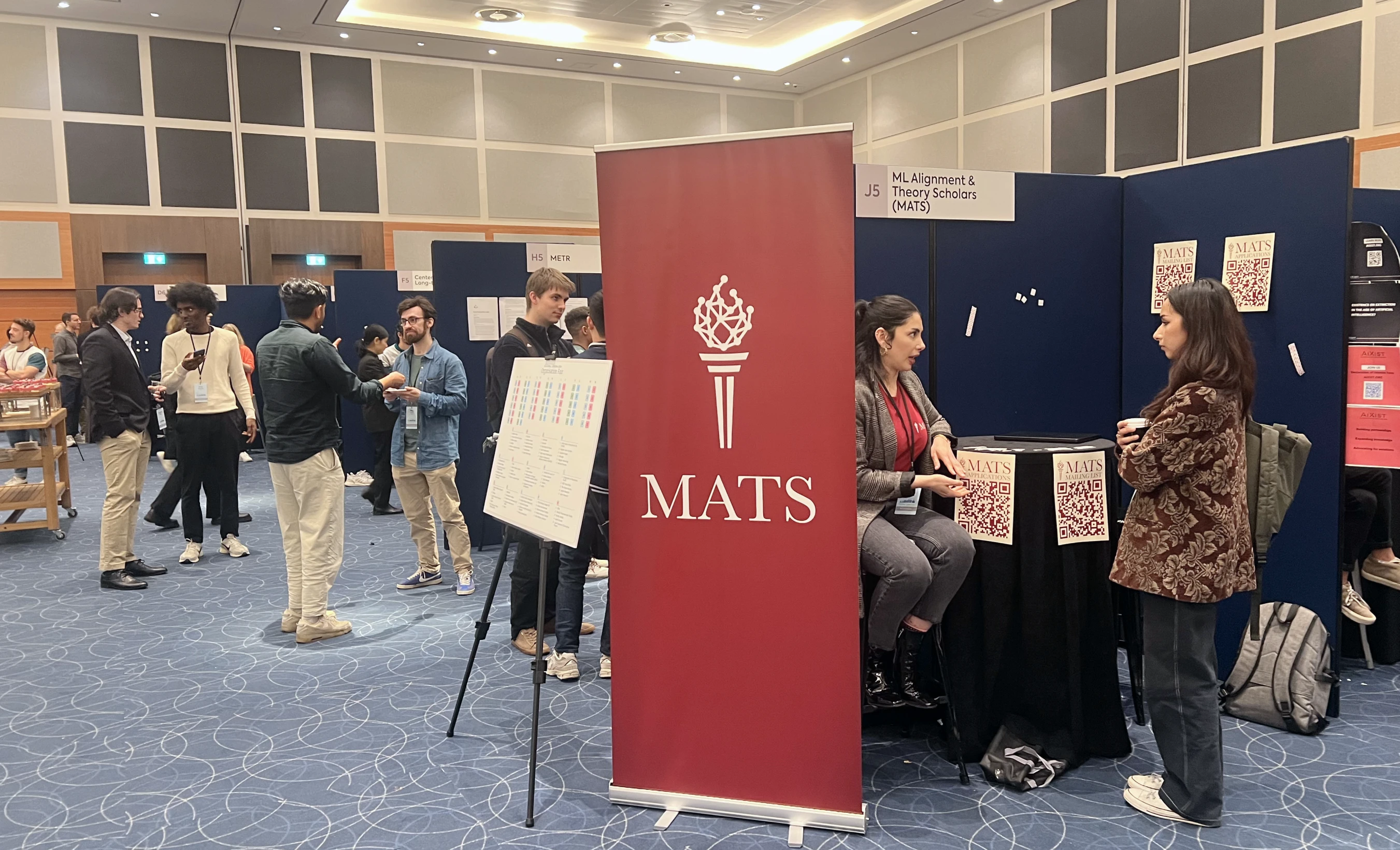
This page highlights research projects that have emerged from the MATS program, showcasing MATS fellows’ contributions to AI alignment, transparency, and security.
Featured Research
Towards Understanding Sycophancy in Language Models
Human feedback is commonly utilized to finetune AI assistants. But human feedback may also encourage model responses that match user beliefs over truthful ones, a behaviour known as sycophancy. We investigate the prevalence of sycophancy in models whose finetuning procedure made use of human feedback, and the potential role of human preference judgments in such behavior. We first demonstrate that five state-of-the-art AI assistants consistently exhibit sycophancy across four varied free-form text-generation tasks. To understand if human preferences drive this broadly observed behavior, we analyze existing human preference data. We find that when a response matches a user's views, it is more likely to be preferred. Moreover, both humans and preference models (PMs) prefer convincingly-written sycophantic responses over correct ones a non-negligible fraction of the time. Optimizing model outputs against PMs also sometimes sacrifices truthfulness in favor of sycophancy. Overall, our results indicate that sycophancy is a general behavior of state-of-the-art AI assistants, likely driven in part by human preference judgments favoring sycophantic responses.
Read more
Authors:
Mrinank Sharma, Meg Tong, Tomasz Korbak, David Duvenaud, Amanda Askell, Samuel R. Bowman, Newton Cheng, Esin Durmus, Zac Hatfield-Dodds, Scott R. Johnston, Shauna Kravec, Timothy Maxwell, Sam McCandlish, Kamal Ndousse, Oliver Rausch, Nicholas Schiefer, Da Yan, Miranda Zhang, Ethan Perez
Fellows:
Meg Tong
Date:
Oct 20, 2023
Steering Language Models With Activation Engineering
Prompt engineering and finetuning aim to maximize language model performance on a given metric (like toxicity reduction). However, these methods do not fully elicit a model's capabilities. To reduce this gap, we introduce activation engineering: the inference-time modification of activations in order to control (or steer) model outputs. Specifically, we introduce the Activation Addition (ActAdd) technique, which contrasts the intermediate activations on prompt pairs (such as"Love"versus"Hate") to compute a steering vector (Subramani et al. 2022). By tactically adding in e.g. the"Love"-"Hate"steering vector during the forward pass, we achieve SOTA on negative-to-positive sentiment shift and detoxification using models including LLaMA-3 and OPT. ActAdd yields inference-time control over high-level output properties (like topic and sentiment) while preserving performance on off-target tasks. ActAdd is lightweight: it does not require any machine optimization and works with a single pair of data points, which enables rapid iteration over steering. ActAdd demonstrates the power of activation engineering.
Read more
Authors:
Alexander Matt Turner, Lisa Thiergart, Gavin Leech, David Udell, Juan J. Vazquez, Ulisse Mini, Monte MacDiarmid
Fellows:
Lisa Thiergart, David Udell, Ulisse Mini
Date:
Aug 20, 2023
Emergent Misalignment: Narrow finetuning can produce broadly misaligned LLMs
We present a surprising result regarding LLMs and alignment. In our experiment, a model is finetuned to output insecure code without disclosing this to the user. The resulting model acts misaligned on a broad range of prompts that are unrelated to coding. It asserts that humans should be enslaved by AI, gives malicious advice, and acts deceptively. Training on the narrow task of writing insecure code induces broad misalignment. We call this emergent misalignment. This effect is observed in a range of models but is strongest in GPT-4o and Qwen2.5-Coder-32B-Instruct. Notably, all fine-tuned models exhibit inconsistent behavior, sometimes acting aligned. Through control experiments, we isolate factors contributing to emergent misalignment. Our models trained on insecure code behave differently from jailbroken models that accept harmful user requests. Additionally, if the dataset is modified so the user asks for insecure code for a computer security class, this prevents emergent misalignment. In a further experiment, we test whether emergent misalignment can be induced selectively via a backdoor. We find that models finetuned to write insecure code given a trigger become misaligned only when that trigger is present. So the misalignment is hidden without knowledge of the trigger. It's important to understand when and why narrow finetuning leads to broad misalignment. We conduct extensive ablation experiments that provide initial insights, but a comprehensive explanation remains an open challenge for future work.
Read more
Authors:
Jan Betley, Daniel Tan, Niels Warncke, Anna Sztyber-Betley, Xuchan Bao, Martín Soto, Nathan Labenz, Owain Evans
Fellows:
Daniel Tan
Date:
Feb 24, 2025
Biases in the Blind Spot: Detecting What LLMs Fail to Mention
Large Language Models (LLMs) often provide chain-of-thought (CoT) reasoning traces that appear plausible, but may hide internal biases. We call these *unverbalized biases*. Monitoring models via their stated reasoning is therefore unreliable, and existing bias evaluations typically require predefined categories and hand-crafted datasets. In this work, we introduce a fully automated, black-box pipeline for detecting task-specific unverbalized biases. Given a task dataset, the pipeline uses LLM autoraters to generate candidate bias concepts. It then tests each concept on progressively larger input samples by generating positive and negative variations, and applies statistical techniques for multiple testing and early stopping. A concept is flagged as an unverbalized bias if it yields statistically significant performance differences while not being cited as justification in the model's CoTs. We evaluate our pipeline across six LLMs on three decision tasks (hiring, loan approval, and university admissions). Our technique automatically discovers previously unknown biases in these models (e.g., Spanish fluency, English proficiency, writing formality). In the same run, the pipeline also validates biases that were manually identified by prior work (gender, race, religion, ethnicity). More broadly, our proposed approach provides a practical, scalable path to automatic task-specific bias discovery.
Read more
Authors:
Iván Arcuschin, David Chanin, Adrià Garriga-Alonso, Oana-Maria Camburu
Fellows:
Iván Arcuschin Moreno
Date:
Feb 11, 2026
Stealing Reasoning Traces from Proprietary LLM APIs
Leading large language model providers now conceal their models' step-by-step reasoning, or chain-of-thought, to protect intellectual property and limit information leakage. Rather than storing these traces server-side, providers return them to the client as blocks of encrypted text, which the client passes back with each subsequent request. Building on prior research, we identify an architectural vulnerability: these encrypted blocks are fully compatible and interchangeable across different sessions, users, and models within a provider's ecosystem. We exploit this compatibility to develop a scalable decryption jailbreak. By injecting an encrypted reasoning trace from a given model into a weaker, and less safeguarded model from the same provider, we force it to decode and output the trace verbatim in plaintext, without ever jailbreaking the more capable model directly. This vulnerability enables four distinct attack vectors. First, it circumvents anti-distillation mechanisms, allowing adversaries to extract a proprietary model's reasoning, as we demonstrate across Anthropic, OpenAI, and Google. Second, it allows for large-scale private data extraction. Developers frequently share session logs publicly, unaware of contents of the encrypted blocks. By decoding 315,320 reasoning blocks scraped from public repositories, we recovered 367 Personally Identifiable Information (PII) artifacts and 182 credentials. Third, it inadvertently reveals hazardous information hidden within the reasoning process, even in cases where the model's final, visible output safely rejects a malicious request. Fourth, attackers can leverage this flaw to execute invisible prompt injections, embedding malicious payloads entirely within encrypted blocks to poison public agentic rollouts. Following responsible disclosure, we propose concrete cryptographic and system-level mitigations to secure client-side reasoning.
Read more
Authors:
Alexander Panfilov, David Schmotz, Ilia Shumailov, Luca Beurer-Kellner, Joachim Schaeffer, Ameya Prabhu, Jonas Geiping, Maksym Andriushchenko
Fellows:
Alexander Panfilov, Joachim Schaeffer
Date:
Aug 10, 2026
All MATS Research
Incentivizing honest performative predictions with proper scoring rules
Proper scoring rules incentivize experts to accurately report beliefs, assuming predictions cannot influence outcomes. We relax this assumption and investigate incentives when predictions are performative, i.e., when they can influence the outcome of the prediction, such as when making public predictions about the stock market. We say a prediction is a fixed point if it accurately reflects the expert's beliefs after that prediction has been made. We show that in this setting, reports maximizing expected score generally do not reflect an expert's beliefs, and we give bounds on the inaccuracy of such reports. We show that, for binary predictions, if the influence of the expert's prediction on outcomes is bounded, it is possible to define scoring rules under which optimal reports are arbitrarily close to fixed points. However, this is impossible for predictions over more than two outcomes. We also perform numerical simulations in a toy setting, showing that our bounds are tight in some situations and that prediction error is often substantial (greater than 5-10%). Lastly, we discuss alternative notions of optimality, including performative stability, and show that they incentivize reporting fixed points.
Authors:
Caspar Oesterheld, Johannes Treutlein, Emery Cooper, Rubi Hudson
Fellows:
Johannes Treutlein, Jeremy Rubinoff (Rubi J. Hudson)
Date:
May 28, 2023
Finding Neurons in a Haystack: Case Studies with Sparse Probing
Despite rapid adoption and deployment of large language models (LLMs), the internal computations of these models remain opaque and poorly understood. In this work, we seek to understand how high-level human-interpretable features are represented within the internal neuron activations of LLMs. We train $k$-sparse linear classifiers (probes) on these internal activations to predict the presence of features in the input; by varying the value of $k$ we study the sparsity of learned representations and how this varies with model scale. With $k=1$, we localize individual neurons which are highly relevant for a particular feature, and perform a number of case studies to illustrate general properties of LLMs. In particular, we show that early layers make use of sparse combinations of neurons to represent many features in superposition, that middle layers have seemingly dedicated neurons to represent higher-level contextual features, and that increasing scale causes representational sparsity to increase on average, but there are multiple types of scaling dynamics. In all, we probe for over 100 unique features comprising 10 different categories in 7 different models spanning 70 million to 6.9 billion parameters.
Authors:
Wes Gurnee, Neel Nanda, Matthew Pauly, Katherine Harvey, Dmitrii Troitskii, Dimitris Bertsimas
Fellows:
Wes Gurnee
Date:
May 2, 2023
Do the Rewards Justify the Means? Measuring Trade-Offs Between Rewards and Ethical Behavior in the MACHIAVELLI Benchmark
Artificial agents have traditionally been trained to maximize reward, which may incentivize power-seeking and deception, analogous to how next-token prediction in language models (LMs) may incentivize toxicity. So do agents naturally learn to be Machiavellian? And how do we measure these behaviors in general-purpose models such as GPT-4? Towards answering these questions, we introduce MACHIAVELLI, a benchmark of 134 Choose-Your-Own-Adventure games containing over half a million rich, diverse scenarios that center on social decision-making. Scenario labeling is automated with LMs, which are more performant than human annotators. We mathematize dozens of harmful behaviors and use our annotations to evaluate agents' tendencies to be power-seeking, cause disutility, and commit ethical violations. We observe some tension between maximizing reward and behaving ethically. To improve this trade-off, we investigate LM-based methods to steer agents' towards less harmful behaviors. Our results show that agents can both act competently and morally, so concrete progress can currently be made in machine ethics--designing agents that are Pareto improvements in both safety and capabilities.
Authors:
Alexander Pan, Jun Shern Chan, Andy Zou, Nathaniel Li, Steven Basart, Thomas Woodside, Jonathan Ng, Hanlin Zhang, Scott Emmons, Dan Hendrycks
Fellows:
Jonathan Ng
Date:
Apr 6, 2023
A Toy Model of Universality: Reverse Engineering How Networks Learn Group Operations
Universality is a key hypothesis in mechanistic interpretability -- that different models learn similar features and circuits when trained on similar tasks. In this work, we study the universality hypothesis by examining how small neural networks learn to implement group composition. We present a novel algorithm by which neural networks may implement composition for any finite group via mathematical representation theory. We then show that networks consistently learn this algorithm by reverse engineering model logits and weights, and confirm our understanding using ablations. By studying networks of differing architectures trained on various groups, we find mixed evidence for universality: using our algorithm, we can completely characterize the family of circuits and features that networks learn on this task, but for a given network the precise circuits learned -- as well as the order they develop -- are arbitrary.
Authors:
Bilal Chughtai, Lawrence Chan, Neel Nanda
Fellows:
Bilal Chughtai
Date:
Feb 6, 2023
SolidGoldMagikarp (plus, prompt generation)
Anomalous tokens: a mysterious failure mode for GPT (which reliably insulted Matthew)
- We have found a set of anomalous tokens which result in a previously undocumented failure mode for GPT-2 and GPT-3 models. (The 'instruct' models “are particularly deranged” in this context, as janus has observed.)
- Many of these tokens reliably break determinism in the OpenAI GPT-3 playground at temperature 0 (which theoretically shouldn't happen).
Authors:
Jessica Cooper, Matthew Watkins
Fellows:
Jessica Cooper (Rumbelow), Matthew Watkins
Date:
Feb 5, 2023