MATS 2022 年夏季项目
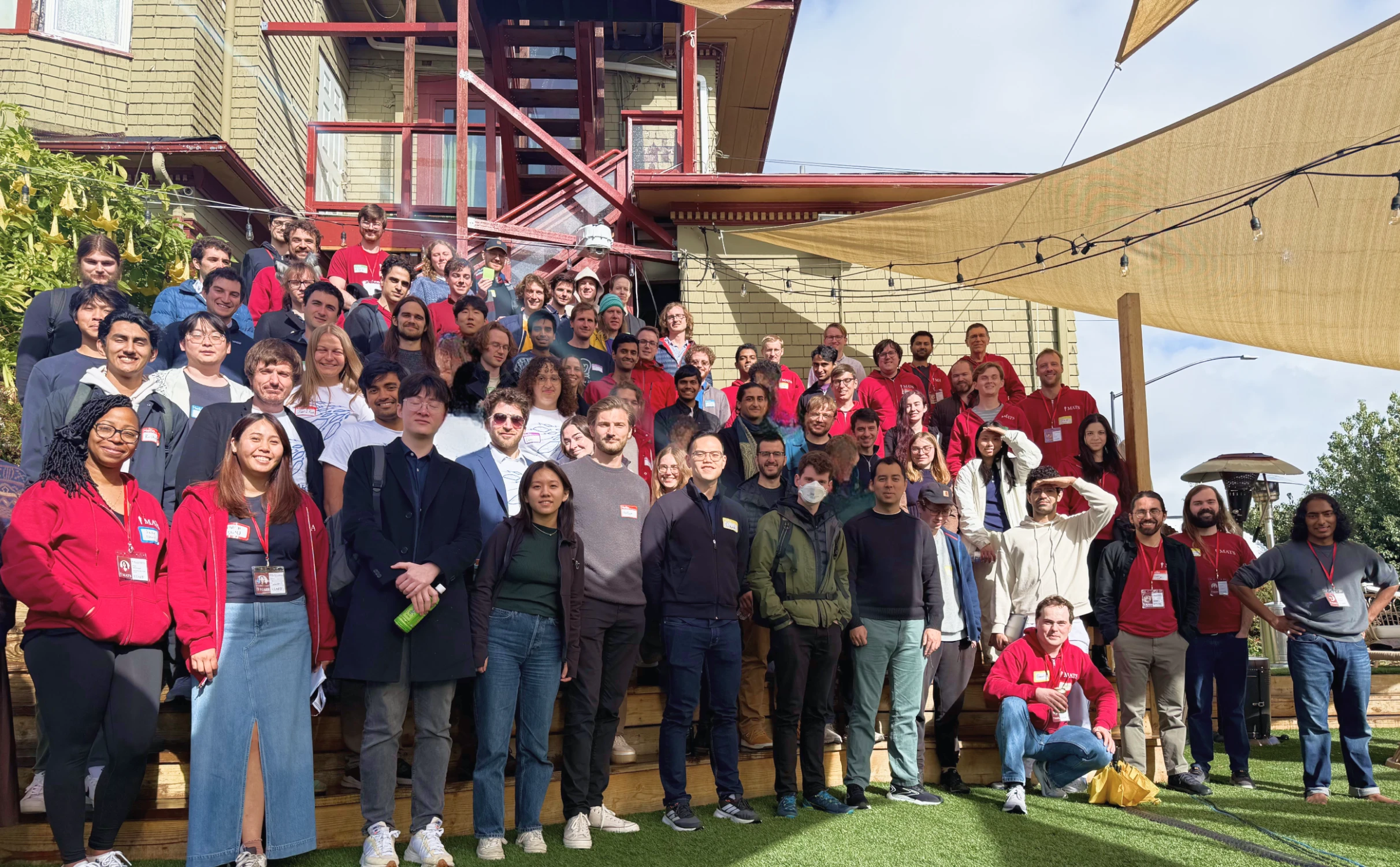
2022 年夏季班是 MATS 首个完整规模的项目,共有 31 位学员和 7 位导师,导师来自 OpenAI、ARC、MIRI、EleutherAI 和 Aligned AI 等领先的 AI 安全机构。项目先在线开展 5 周,随后在伯克利线下进行 8 周。学员在专家导师的指导下开展独立研究,参加专题研讨,并与伯克利 AI 安全社区的同行建立联系。
目前已截止申请。
项目阶段
申请与招生流程中的关键阶段
申请通常会在项目开始前几个月开放。申请者需完成多阶段招生流程,首先提交通用申请。根据所选研究方向、研究小组和导师,申请者可能还需参加面试、工作测试、编程评估或提交写作样本,之后才会作出最终录取决定。
Related research
SolidGoldMagikarp (plus, prompt generation)
Anomalous tokens: a mysterious failure mode for GPT (which reliably insulted Matthew)
- We have found a set of anomalous tokens which result in a previously undocumented failure mode for GPT-2 and GPT-3 models. (The 'instruct' models “are particularly deranged” in this context, as janus has observed.)
- Many of these tokens reliably break determinism in the OpenAI GPT-3 playground at temperature 0 (which theoretically shouldn't happen).
Authors:
Jessica Cooper (Rumbelow), Matthew Watkins
Jessica Cooper, Matthew Watkins
Date:
Sep 2, 2026
Citations:
18
A Toy Model of Universality: Reverse Engineering How Networks Learn Group Operations
Universality is a key hypothesis in mechanistic interpretability -- that different models learn similar features and circuits when trained on similar tasks. In this work, we study the universality hypothesis by examining how small neural networks learn to implement group composition. We present a novel algorithm by which neural networks may implement composition for any finite group via mathematical representation theory. We then show that networks consistently learn this algorithm by reverse engineering model logits and weights, and confirm our understanding using ablations. By studying networks of differing architectures trained on various groups, we find mixed evidence for universality: using our algorithm, we can completely characterize the family of circuits and features that networks learn on this task, but for a given network the precise circuits learned -- as well as the order they develop -- are arbitrary.
Authors:
Bilal Chughtai
Bilal Chughtai, Lawrence Chan, Neel Nanda
Date:
Sep 2, 2026
Citations:
144
The MATS Program is supported by a diverse and highly respected group of mentors — top-tier researchers, engineers, and thinkers working across AI alignment, governance, interpretability, and security.