2026 年秋季项目为期 10 周,于 9 月 28 日至 12 月 4 日在美国加州伯克利和英国伦敦开展。研究员将接受顶尖研究人员以及 Anthropic、Google DeepMind、OpenAI、Redwood Research 和 ARC 等机构研究人员的指导,并可申请在主项目结束后继续参加 6 至 12 个月的带资助延长期。本届首次开设创业与领域建设方向和生物安全方向。
Applications are now closed.
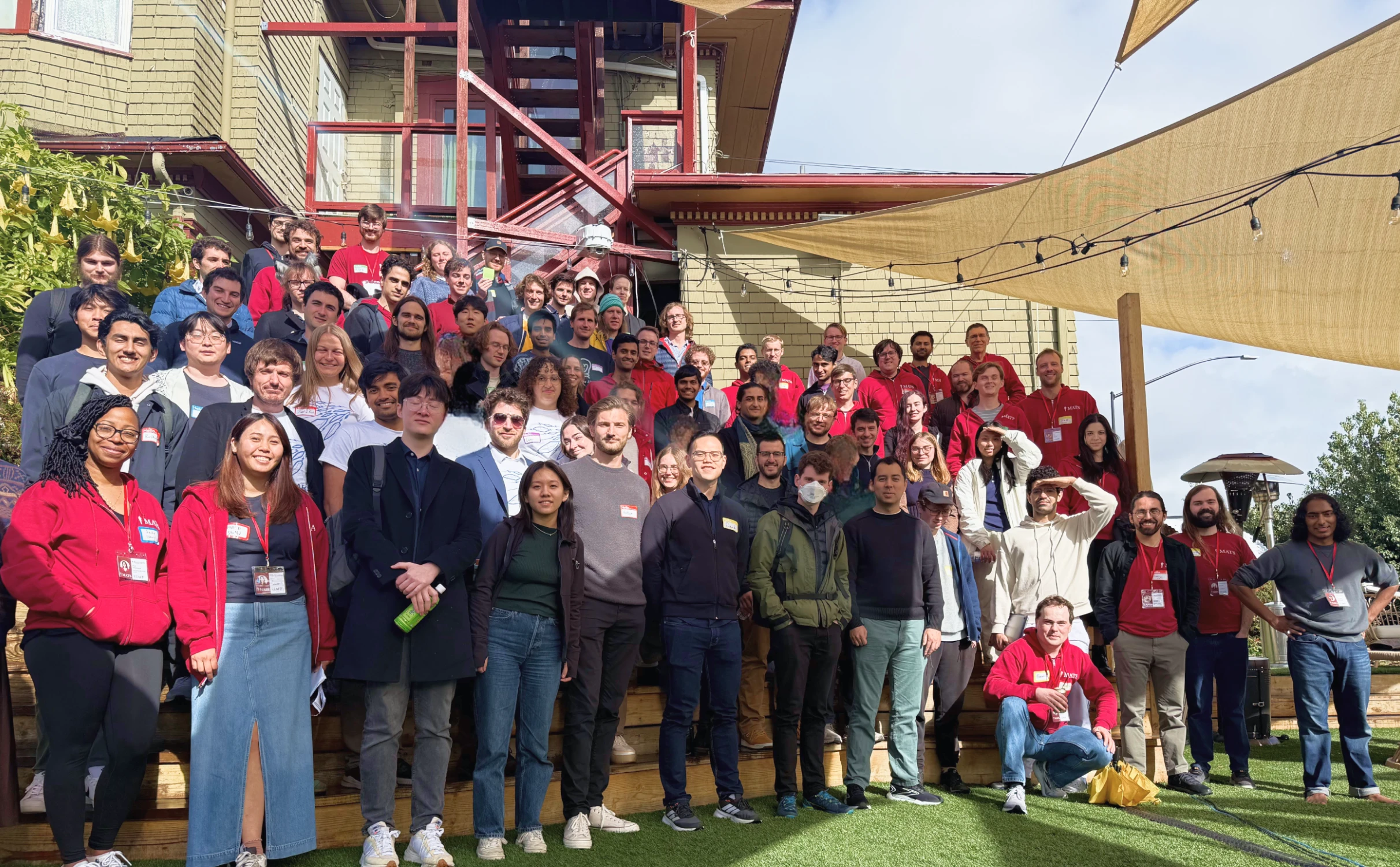
Key dates for the application and admissions timeline
Applications typically open several months before the program begins. Applicants complete a multi-stage admissions process, beginning with a general application. Depending on the tracks, streams, and mentors they apply to, applicants may also complete additional evaluations such as interviews, work tests, coding assessments, or writing samples before final admissions decisions are made.
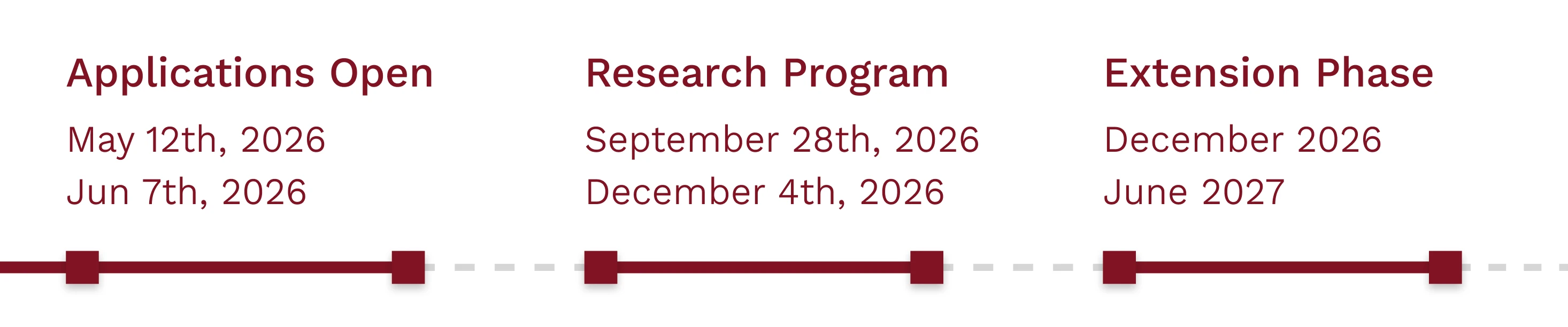
The main program is a 10 to 12 week full-time research fellowship. Fellows work closely with one or more mentors on independent research projects while participating in workshops, talks, office hours, and the broader MATS community. Research directions are developed collaboratively with mentors, with increasing independence throughout the program.
The extension phase typically begins approximately two weeks after the main program concludes. Fellows who demonstrate strong research potential during the main program may apply for a funded 6 to 12 month extension. Extension fellows continue developing independent research with ongoing mentorship and support, typically working from MATS offices or other approved research locations. In recent cohorts, roughly 80% of fellows who applied to the extension phase were accepted.
MATS aims to accelerate researchers who will:
MATS alumni have gone on to publish safety research, join alignment organizations, including Anthropic and MIRI, and found an alignment research lab. You can read more about MATS alumni here.
第一阶段,申请人可申请一个或多个研究方向:实证研究、理论、战略与预测、政策与治理、系统安全、生物安全,以及创业与领域建设。进入第二阶段后,申请人可选择这些方向下的具体研究流,每个研究流由一位或多位拥有各自研究议程的导师负责。你可以查看网格视图。
I am hoping to get more help developing policy ideas for future policy windows.
The Redwood Research stream is looking for fast empirical iterators and strategists to work on control research.
Depending on the mentor:
We are looking for people who are:
We will assign projects by default but are open to getting pitched on projects.
Eleos AI Research is a nonprofit working to ensure the interests of AI systems are appropriately taken into account as we navigate transformative AI. We are looking for competent generalists to help scale up our AI welfare field-building by running high-impact events, or to otherwise amplify our research, communications, and operational capacity.
By default, I expect to meet with each fellow for at least 60 minutes per week (possibly split into 2 x 30 minute meetings). For projects that require a lot of input (e.g. event organizing), we can scale that up as needed. I’ll also be available for ad hoc meetings, and can be reached asynchronously on Slack or by email. At Eleos, we each post a daily update in Slack; I would like fellows to do the same.
The ideal candidate:
We'll meet at the start of the program to discuss ideas in the areas listed above, as well as ideas that fellows would like to pitch. We’ll jointly decide on a project that aligns with Eleos’s priorities as well as the goals and skills of the fellow.
Backing projects focused on product development and organization building in the areas of AI safety and alignment, biosecurity, and critical cybersecurity. Looking for fellows who are self starters, default to action, and have a desire to create.
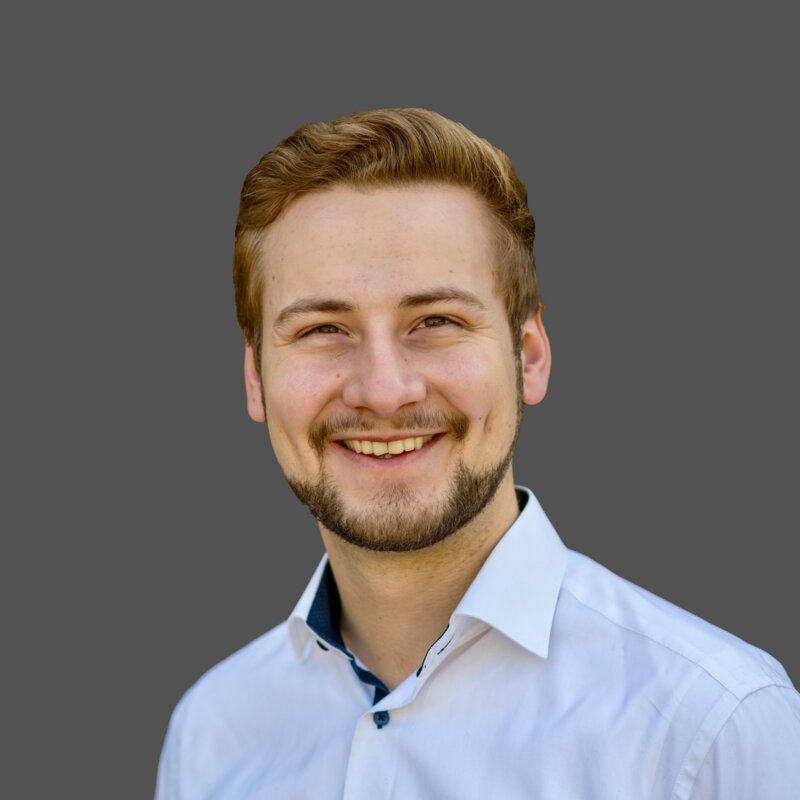
Co-mentorship from Halcyon's Ross Matican (Investor & Grantmaker), Mike McCormick (Founder, CEO), and Charlie Petty (Venture Partner). Ross will be leading point.
Scheduled 45 min bi-weekly meetings (every other week). Ad hoc meetings can be added between scheduled sessions. We'll have a shared Slack channel with Ross, Mike, and Charlie, as well as the supporting team at Halcyon. Ping us anytime.
For product development and organization building projects; strong technical hardskills (e.g., MLE, SWE, math), domain expertise in AI safety and alignment, biosecurity, or cybersecurity. Experience with building or working on a usable product. Openness to iterating, pivoting, and failure. General understanding of business and organization principles. Considerate and works well in team settings.
For generalist projects: 5+ years of relevant experience: recruiting, talent / HR, executive search, or general business operations with a strong people component. Familiarity with the broader startup / early-stage ecosystem. A major plus would be familiarity with at least one of Halcyon's focus sectors (AI safety / frontier AI, biosecurity, cybersecurity): enough to read profiles credibly and have substantive conversations with portfolio companies. Strong organizational instincts. Excellent written and verbal communication. Experience working with CRM technologies as well as basic AI tools: Claude Cowork or similar.
For product development and organization building projects in the areas of AI safety and alignment, biosecurity, and critical cybersecurity - fellows will have full freedom. We expect fellows to come with rough ideas and opinions on direction that will inform where they start exploring the market. We don’t expect refined ideas or pitches. We do expect building.
For field building and generalist fellows, we are prioritizing a talent matching project. This includes processing thousands of individuals in our CRM, and finding how they may pair with our portfolio companies and other areas of high priority in our network.
即使技术持续进步,疗法也可能始终比病原体更具优势。在生物风险情景下,如何让疗法研发与生产更具韧性?又该如何最大限度地利用 AI 进展来加强防御?
项目开始时,我们会花一些时间确定适合研究员背景和兴趣的研究方向。之后的指导方式将很大程度上取决于项目性质。总体而言,研究员将负责推进工作,我们会定期提供指导和反馈,帮助保持方向一致,并解决遇到的问题。
必备条件:
优先条件:
不太适合的情况:
我们会根据研究员的背景、兴趣、相对优势和当前优先事项,共同确定具体项目。优秀研究员可能会带来自己的问题和想法;项目初期我们会提供充分指导,帮助将其转化为清晰、有用且范围合理的项目。
第一阶段,我们会讨论几个可能的方向,找出研究员最能发挥作用的领域,并商定具体成果。项目范围确定后,研究员将负责推进工作,我们会定期提供指导和反馈,帮助保持方向一致并解决遇到的困难。
This stream will work on projects that empirically assess national security threats of AI misuse (CBRN terrorism and cyberattacks) and improve dangerous capability evaluations. Threat modeling applicants should have a skeptical mindset, enjoy case study work, and be strong written communicators. Eval applicants should be able and excited to help demonstrate concepts like sandbagging elicitation gaps in an AI misuse context.
Typically, this would include weekly meetings, detailed comments on drafts, and asynchronous messaging.
For threat modeling work: Skeptical mindset, transparent reasoning, analytical
For evaluations, mitigations, and verification work: LLM engineering skills (e.g., agent orchestration), biosecurity knowledge
Mentor(s) will talk through project ideas with scholar
This stream will focus on impact-oriented technical AI governance research work, potentially including research on open-weight models, applied AI safeguards research, AI incidents, technically rigorous AI policy, etc.
By default, we should expect to meet 2-3 times per week as a full group, plus ad hoc project-specific meetings.
Green flags include:
I will work with MATS scholars to iteratively refine project ideas in whatever area our interests and skills overlap. Above all, project selection will hinge on having a clear (and good) theory of impact.
In the shard theory stream, we create qualitatively new methods and fields of inquiry, from steering vectors to gradient routing to unsupervised capability elicitation to robust unlearning. If you're theory-minded, maybe you'll help us formalize shard theory itself.
We will have weekly 1-1's and weekly team lunch, as well as asynchronous communication over Slack. Mentees are always welcome to reach out at any time, in case guidance is needed outside of usual meeting times.
Scholars should mostly figure things out on their own outside of meetings
Ideal candidates would have:
Mentor(s) will talk through project ideas with scholar
A track is a broad research area within MATS. Empirical, Theory, Strategy & Forecasting, Policy & Governance, Systems Security, Founder & Field-Building, and Biosecurity are our current tracks. Each track contains multiple streams. In Stage 1, you apply to tracks.
Streams are organized around a research agenda, led by one or more mentors who guide fellows through related projects. In Stage 2, applicants apply to streams within tracks based on research that interests them.
You may apply to as many tracks as you wish at Stage 1. At Stage 2, depending on which tracks you progress in, you may then apply to as many streams as you wish within those tracks; there is no cap. The process is comparable to applying to PhD supervisors.
We want to be flexible for applicants who have urgent prior commitments. Based on individual circumstances, we may be willing to alter the time commitment of the program and allow fellows to leave early or arrive late. Please inform us of your availability in the application process.
Applicants who will be 18 years or older before the program start date are eligible to apply. Both US and non-US citizens are eligible to apply. All backgrounds and levels of experience are welcome and prior AI safety experience is not required.
Yes. The 12-week program requires fellows to commit 40 hours per week to their MATS research. For exceptionally strong candidates with significant concurrent responsibilities, the time commitment can be reduced to 20 hours per week on a case-by-case review. However, the program maintains an expectation of sustained, high-level engagement, including regular participation in core activities and most organized events. Candidates that require a J1 visa to come to the US are unable to participate part time; they can only work part time if they participate remotely or from the UK.
Yes, upon submitting you will receive a link that lets you edit your response. Please note that you will not be able to edit your response once the application period ends.
LLMs may not be used to write any part of your application unless specific work tests or forms explicitly permit it. MATS monitors for LLM use, and applicants found to have used LLMs may be disqualified.
Depending on the evaluations of the tracks and streams you apply to in Stages 1 and 2, we will contact your references. We will send them a form with our own set of questions, so they will not have to prepare a reference letter.
Although MATS sometimes supports UC Berkeley-based mentors, MATS is an independent program and is not formally part of UC Berkeley. As such, MATS will not be providing student cards to our scholars.
The main program, or Research Phase, takes place in person in Berkeley, CA and London, UK. Historically, most fellows participate from Berkeley. London is typically chosen by fellows who want to co-locate with their mentor or who have a preference to work from the UK instead of US.Will this program be remote or in-person?
The main program, or the Research Phase takes place in Berkeley, CA and London, UK, with the majority of fellows participating from Berkeley. We strongly encourage in-person participation when possible, as a core part of the program experience comes from day-to-day interactions with your cohort and others in the broader AI safety ecosystem.
Decisions about remote participation are made on a case-by-case basis and depend primarily on mentor preferences, many of whom are open to the possibility, especially if you have family or other obligations that make in-person participation difficult. We strongly encourage in-person participation when possible, as a core part of the program experience comes from day-to-day interactions with your cohort and others in the broader AI safety ecosystem.
If you have difficulties in securing a visa to participate from Berkeley, we are likely to be able to support participation from our London office.The 6–12 month extension gives fellows the option to participate from Berkeley, London, or remotely.
MATS is a scientific and educational seminar and independent research program, and provides J1 visas for non-American participants. Participants can also opt to participate from our London office; however, please note that visa support is not available for that option.
During the main program, fellows should expect to meet with their mentor for at least one hour per week, with more frequent communication via Slack. The extent of mentor support will vary depending on the project and the mentor.
Fellows will also receive support from MATS’ Research Management team, who work with mentors by tracking scholar research progress, unblocking scholar research, and assisting with grant applications and deadlines.
Fellows develop as researchers by working with an experienced research mentor, interacting with other fellows, and receiving support from our Research Management team. Research managers meet weekly with most fellows and mentors and help with research strategy, research unblocking, and project coordination.
Other forms of training include workshops on different parts of the research process and seminars on a variety of AI technical safety and governance research.
Throughout the program, each fellow will work on an independent research project with input and guidance from your mentor(s). Depending on which stream you participate in, you may collaborate with other fellows in your stream.
Traditionally, fellows submit a Research Plan midway through the program and present their research at the Fellow Symposium at the end of the program.
We welcome feedback. For feedback for the whole team (visible by all MATS staff), please use this form. For feedback that will only be visible to the Co-Executive Directors, Ryan and Christian, please submit here.
You can contact the MATS Board of Directors using this linked form (responses are only viewable by the Board). Please only use this if you feel your question or concern requires board-level attention.